
8th Pay Commission: From ₹55 to ₹18,000, Here’s How Minimum Basic Pay Changed From 1st to 7th Pay Commission
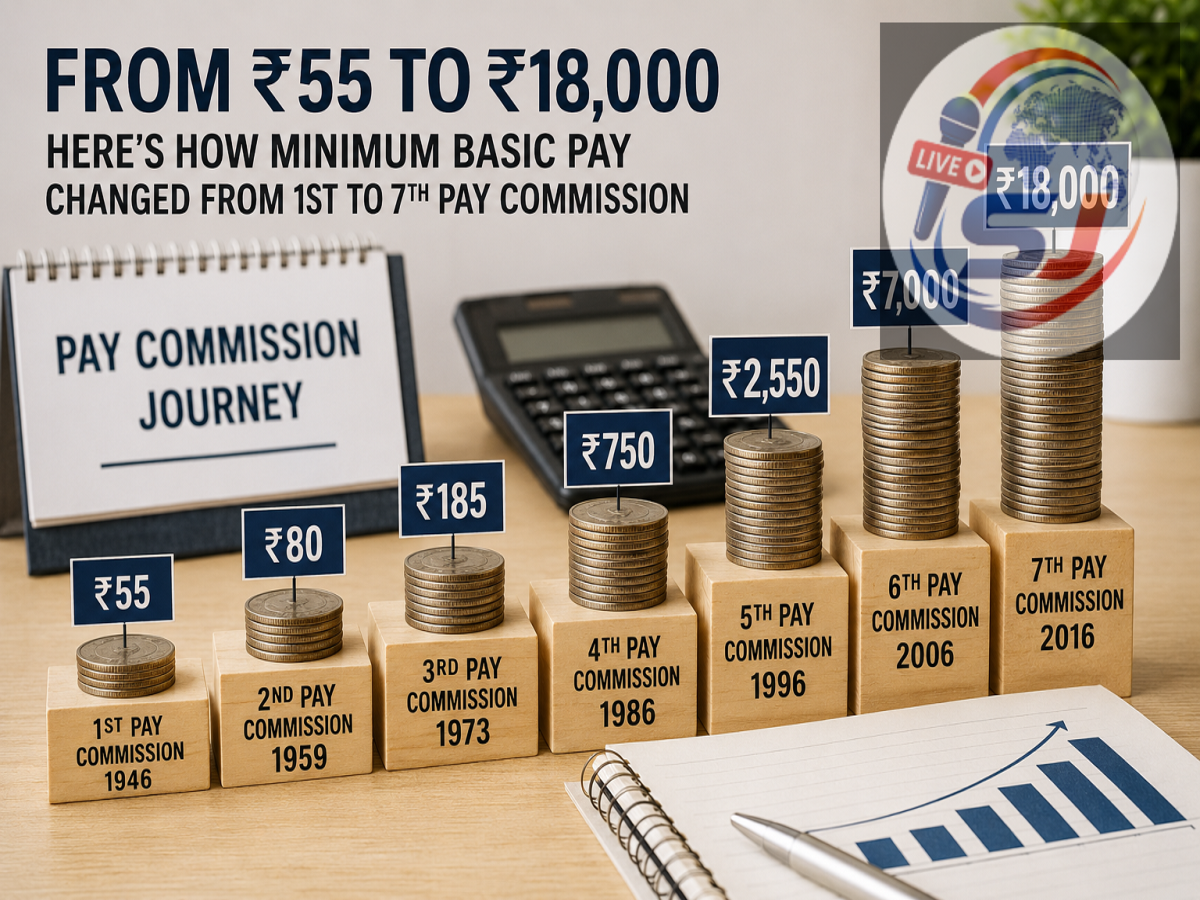
8th Pay Commission Minimum Basic Pay: Central government employees are closely watching the 8th Pay Commission for a possible revision in basic salary, pension and fitment factor. Here’s how minimum basic pay has changed since the first Pay Commission and what employees are expecting next.
The 8th Pay Commission has become one of the most closely watched developments for central government employees and pensioners. Expectations are high that the new commission could recommend another major revision in salaries, pensions, allowances and the overall pay structure.
The commission, headed by Justice Ranjana Prakash Desai, was constituted on November 3, 2025. It has been given an 18-month period to submit its recommendations. Meanwhile, consultations with employee organisations, unions and other stakeholders are continuing.
While there is considerable discussion around the possible fitment factor and minimum basic pay under the 8th Pay Commission, no final figure has been announced yet. Before looking at the expectations from the new commission, it is worth understanding how dramatically the minimum salary of central government employees has changed over the decades.
Minimum Basic Pay Rose From ₹55 to ₹18,000
The journey of central government salaries shows a significant transformation. At the time of the 1st Pay Commission, the minimum basic salary was around ₹55 per month.
By the time the 7th Pay Commission was implemented in 2016, minimum basic pay had increased to ₹18,000 per month.
In nominal terms, this means minimum basic salary has increased more than 325 times from the first to the seventh Pay Commission.
The changes were not limited to salaries. Every Pay Commission also attempted to revise allowances, pension benefits and the structure used to determine the salaries of government employees.
How Pay Structure Changed Over the Years
One of the biggest transformations came with the 6th Pay Commission. Instead of continuing with numerous individual pay scales, it introduced the concept of Pay Bands and Grade Pay.
The system was intended to simplify the salary structure and provide a clearer framework for determining an employee's position and compensation.
The 7th Pay Commission subsequently introduced another major change by replacing the Pay Band and Grade Pay system with the Pay Matrix.
Under this system, government employees are placed at different pay levels, making it easier to understand basic pay and career progression.
What is the Fitment Factor?
The fitment factor is an important element whenever a new Pay Commission revises salaries.
It is broadly used to determine revised basic pay based on the existing salary structure. Because of this, discussions around the 8th Pay Commission are currently heavily focused on what fitment factor the commission could eventually recommend.
Under the 6th Pay Commission, a fitment factor of 1.86 was associated with the salary revision, while the 7th Pay Commission used 2.57 for determining the minimum basic pay.
The minimum basic pay under the 7th Pay Commission was fixed at ₹18,000 per month, compared with ₹7,000 under the previous commission.
Could Minimum Basic Pay Rise Sharply Under 8th Pay Commission?
Several employee organisations have submitted or discussed demands for a substantial increase in minimum basic salary.
Different fitment-factor figures are also being discussed. However, employees should remember that these figures are currently demands or estimates rather than the final recommendation of the 8th Pay Commission.
For example, simply applying a hypothetical fitment factor of 3.0 to the existing ₹18,000 minimum basic pay would produce ₹54,000. A factor of 3.25 would mathematically result in ₹58,500.
However, this calculation should not be treated as confirmation of the salary employees will receive. The actual methodology adopted by the commission could be different.
What Could Change Besides Basic Salary?
The 8th Pay Commission is important not only because of the expected revision in basic pay. Its recommendations could potentially affect several components of the compensation structure.
Employees and pensioners are particularly watching discussions related to minimum basic pay, fitment factor, pension revision, allowances and the overall pay structure.
Any final change, however, will depend on the commission's recommendations and the central government's subsequent decision.
When Will the 8th Pay Commission Report Come?
The 8th Pay Commission was constituted on November 3, 2025, and was given 18 months to complete its work.
Based on the stated timeline, its recommendations are expected to move toward completion in 2027, with the final report widely expected around the May-June 2027 period.
Until the commission submits its recommendations and the government takes a decision, there is no confirmed minimum basic salary or final fitment factor for the 8th Pay Commission.
Employees Should Treat Salary Figures as Estimates for Now
The history of Pay Commissions shows how dramatically government salaries have evolved—from a minimum basic salary of around ₹55 under the 1st Pay Commission to ₹18,000 under the 7th Pay Commission.
The 8th Pay Commission could mark the next major change in this journey. However, figures being discussed regarding ₹50,000, ₹55,000, ₹60,000 or even higher minimum basic pay should not be considered official unless they form part of the commission's final recommendations and are subsequently approved by the government.
For now, central government employees and pensioners will have to wait for the commission's final recommendations to know exactly how much their basic pay and pension could increase.
Disclaimer: The salary and fitment-factor figures discussed for the 8th Pay Commission are estimates, demands or illustrative calculations unless officially notified. Final salary and pension revisions will depend on the commission's recommendations and the central government's approval.