8th Pay Commission Explained: Expected Salary Hike, Fitment Factor, Pension Revision, Arrears and Pay Matrix
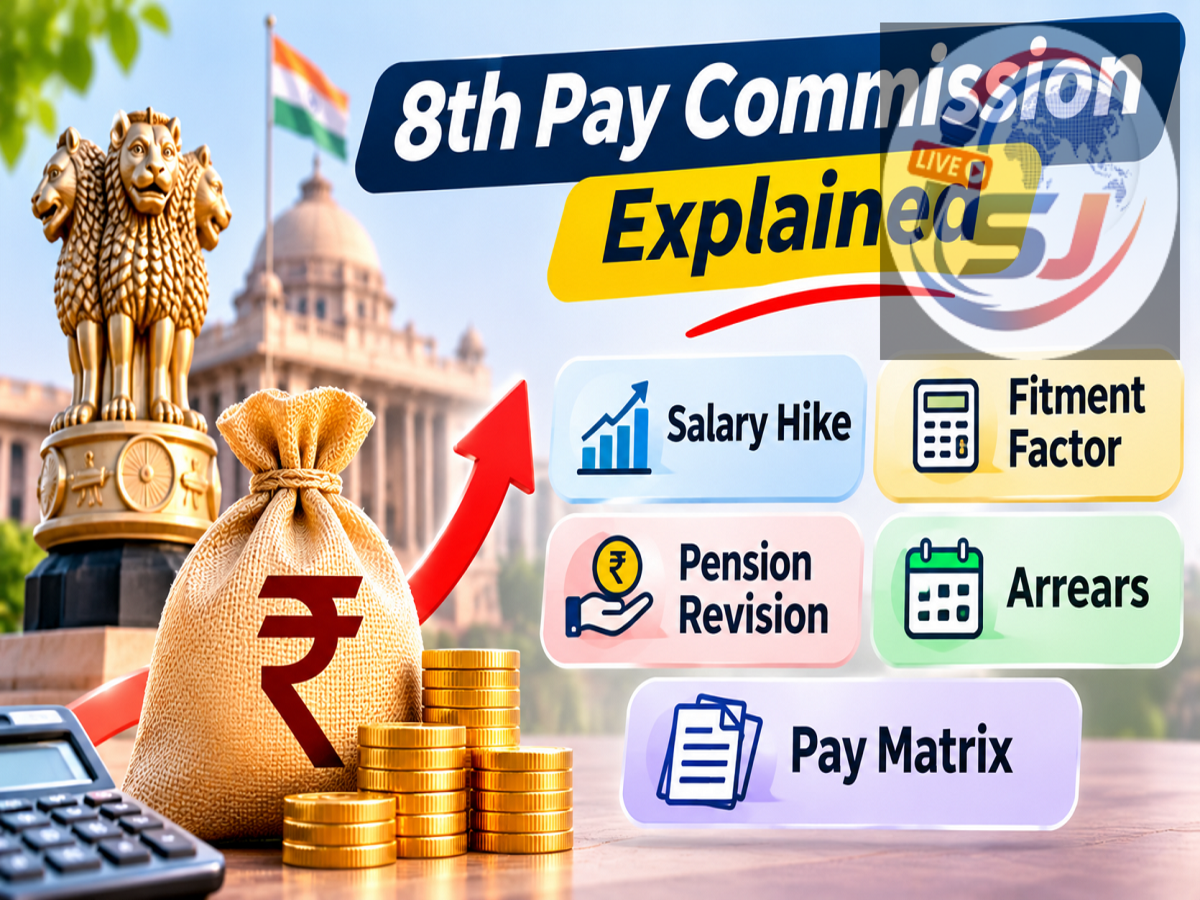
8th Pay Commission Update: Nearly 50 lakh central government employees and 69 lakh pensioners are awaiting the recommendations of the Eighth Central Pay Commission, which will review the existing salary structure, retirement benefits and various allowances.
The upcoming pay revision could bring significant changes to basic salaries, pensions, House Rent Allowance (HRA), Transport Allowance (TA) and other financial benefits. However, the actual increase will depend on the commission's recommendations and their subsequent approval by the Central Government.
The government approved the Terms of Reference (ToR) for the Eighth Pay Commission on October 28, 2025. The commission has been given 18 months from its constitution to submit its recommendations.
Here is a comprehensive guide to the Eighth Pay Commission, its expected implementation timeline, potential salary calculations and benefits for employees and pensioners.
What Is the 8th Central Pay Commission?
A Central Pay Commission is a government-appointed body responsible for reviewing the remuneration structure of central government employees and pensioners.
These commissions generally examine salary structures, inflation, living expenses, retirement benefits, government finances and prevailing economic conditions before recommending changes.
India has implemented the recommendations of seven Central Pay Commissions so far. The Eighth Pay Commission will examine the existing framework established under the Seventh Pay Commission and recommend suitable revisions.
8th Pay Commission: Chairperson and Members
The commission comprises the following members:
| Position |
Name |
|---|---|
| Chairperson |
Justice Ranjana Prakash Desai, former Supreme Court judge |
| Part-Time Member |
Professor Pulak Ghosh, IIM Bangalore |
| Member Secretary |
Pankaj Jain |
The commission will examine various aspects of government compensation and retirement benefits before submitting its recommendations.
When Will the 8th Pay Commission Submit Its Report?
The government has provided an 18-month period for the commission to complete its review and submit recommendations.
Based on its constitution in November 2025, the original timeline points towards approximately May 2027, unless the government grants an extension.
However, submitting the report and implementing its recommendations are separate processes. The government will need to examine the proposals, assess their financial implications and issue the necessary approvals and notifications.
Consequently, employees could receive revised salaries during 2027 or later, depending on the implementation process.
Will the 8th Pay Commission Be Effective From January 2026?
January 1, 2026, is widely discussed as the potential effective date for the revised pay structure, considering the conventional ten-year pay revision cycle.
However, the final effective date and actual payment schedule will depend on the government's official decision.
If the revised salary structure is implemented retrospectively from January 1, 2026, eligible employees and pensioners could receive arrears for the intervening period.
How Much Salary Increase Can Government Employees Expect?
Various estimates suggest that central government employees could receive an overall salary increase of around 30% to 35% under the Eighth Pay Commission.
However, these figures remain speculative.
The actual increase will depend on several factors, including the approved fitment factor, revised pay matrix, treatment of Dearness Allowance (DA), changes in allowances and government approval.
An increase in basic pay should not be confused with an equivalent percentage increase in gross or take-home salary.
What Is the Fitment Factor and How Does It Work?
The fitment factor is a numerical multiplier used to calculate revised basic pay under a new pay structure.
The Seventh Pay Commission adopted a fitment factor of 2.57. Estimates for the Eighth Pay Commission discussed in the original report range between 1.83 and 2.46.
Revised Basic Salary = Existing Basic Salary × Fitment Factor
For example, an employee currently receiving a basic salary of ₹20,000 could see the following hypothetical revisions:
| Fitment Factor |
Estimated Revised Basic Salary |
|---|---|
| 1.83 |
₹36,600 |
| 2.00 |
₹40,000 |
| 2.25 |
₹45,000 |
| 2.46 |
₹49,200 |
| 3.00 |
₹60,000 |
None of these fitment factors has been confirmed in the supplied report.
8th Pay Commission Expected Salary Matrix: Level 1 to Level 18
The following table illustrates potential basic salaries using hypothetical fitment factors of 1.83 and 2.46.
| Pay Matrix Level |
Current Basic Pay |
At 1.83 Fitment Factor |
At 2.46 Fitment Factor |
|---|---|---|---|
| Level 1 |
₹18,000 |
₹32,940 |
₹44,280 |
| Level 2 |
₹19,900 |
₹36,417 |
₹48,954 |
| Level 3 |
₹21,700 |
₹39,711 |
₹53,382 |
| Level 4 |
₹25,500 |
₹46,665 |
₹62,730 |
| Level 5 |
₹29,200 |
₹53,436 |
₹71,832 |
| Level 6 |
₹35,400 |
₹64,782 |
₹87,084 |
| Level 7 |
₹44,900 |
₹82,167 |
₹1,10,454 |
| Level 8 |
₹47,600 |
₹87,108 |
₹1,17,096 |
| Level 9 |
₹53,100 |
₹97,173 |
₹1,30,626 |
| Level 10 |
₹56,100 |
₹1,02,663 |
₹1,38,006 |
| Level 11 |
₹67,700 |
₹1,23,891 |
₹1,66,542 |
| Level 12 |
₹78,800 |
₹1,44,204 |
₹1,93,848 |
| Level 13 |
₹1,23,100 |
₹2,25,273 |
₹3,02,826 |
| Level 14 |
₹1,44,200 |
₹2,63,886 |
₹3,54,732 |
| Level 15 |
₹1,82,200 |
₹3,33,426 |
₹4,48,212 |
| Level 16 |
₹2,05,400 |
₹3,75,882 |
₹5,05,284 |
| Level 17 |
₹2,25,000 |
₹4,11,750 |
₹5,53,500 |
| Level 18 |
₹2,50,000 |
₹4,57,500 |
₹6,15,000 |
Note: These figures have been recalculated to correct arithmetic discrepancies in the original article. They are illustrative projections, not an officially approved pay matrix. The treatment of existing DA and the final salary fixation formula will depend on government notifications.
Will House Rent Allowance Increase Under the 8th Pay Commission?
House Rent Allowance is another important component of government employees' compensation.
Under the Seventh Pay Commission framework, HRA was initially structured at 24%, 16% and 8% for X, Y and Z category cities, respectively. These rates were subsequently linked to specified DA thresholds.
Considering rising residential rental expenses across metropolitan cities and other urban areas, the Eighth Pay Commission may review the existing HRA framework.
Employees could benefit from revised allowance rates or higher basic pay, although no new HRA structure has been confirmed in the supplied report.
What Will Happen to Dearness Allowance?
Dearness Allowance is provided to government employees to compensate for inflation and rising living expenses.
During a major pay revision, accumulated DA may be factored into the revised salary structure, depending on the approved formula.
The DA rate could subsequently be reset under the new pay framework, as has happened during previous pay revisions.
Therefore, employees should not assume that the existing DA percentage will automatically continue on the revised basic salary.
How Much Could Pensioners Benefit?
Central government pensioners are also expected to be covered by the Eighth Pay Commission's review.
Potential changes could include revisions to basic pensions, family pensions, minimum pension provisions and Dearness Relief (DR).
For illustration, if the government approves a pension revision using the hypothetical fitment factors discussed above, the calculations could look like this:
| Existing Basic Pension |
At 1.83 Fitment Factor |
At 2.46 Fitment Factor |
|---|---|---|
| ₹9,000 |
₹16,470 |
₹22,140 |
| ₹15,000 |
₹27,450 |
₹36,900 |
| ₹20,000 |
₹36,600 |
₹49,200 |
| ₹25,000 |
₹45,750 |
₹61,500 |
| ₹30,000 |
₹54,900 |
₹73,800 |
| ₹40,000 |
₹73,200 |
₹98,400 |
| ₹50,000 |
₹91,500 |
₹1,23,000 |
These calculations are hypothetical. Pension revision may follow a different formula depending on the final recommendations.
Will Employees Receive 17–18 Months of Arrears?
If the government approves retrospective implementation from January 1, 2026, employees and pensioners may become eligible for arrears.
The arrears would represent the applicable difference between the existing and revised financial benefits for the eligible period.
For example, if an employee's eligible monthly salary difference is ₹15,000, the estimated arrears could be:
| Arrears Period |
Estimated Amount |
|---|---|
| 6 months |
₹90,000 |
| 12 months |
₹1,80,000 |
| 17 months |
₹2,55,000 |
| 18 months |
₹2,70,000 |
| 24 months |
₹3,60,000 |
Whether arrears will be paid in a lump sum or through instalments will depend on the government's final decision. No specific arrears period or payment schedule should be considered guaranteed.
Will Transport and Other Allowances Also Be Revised?
Apart from basic salaries and pensions, the commission may examine several other components of government compensation, including:
-
Transport Allowance (TA).
-
House Rent Allowance (HRA).
-
Dearness Allowance (DA).
-
Medical benefits and applicable allowances.
-
Travel-related benefits.
-
Retirement and gratuity provisions.
-
Other department-specific allowances.
Not all allowances are calculated as a percentage of basic pay. Some have fixed rates or separate eligibility conditions, which may also be reviewed.
Will State Government Employees Receive the Same Benefits?
The Central Pay Commission's recommendations do not automatically apply to state government employees.
Individual state governments may adopt the recommendations, introduce modified salary structures or establish separate pay revision mechanisms.
The implementation timeline and financial benefits may vary across states depending on their budgetary resources and administrative decisions.
Will Private Sector Employees Benefit From the 8th Pay Commission?
Private sector employees are not directly covered by Central Pay Commission recommendations.
Their salaries are determined by individual employers, employment contracts, industry standards and market conditions.
However, an increase in government employees' disposable income could indirectly influence consumer spending, demand for goods and services, and broader economic activity.
8th Pay Commission: Important Details at a Glance
| Particulars |
Details |
|---|---|
| Commission |
Eighth Central Pay Commission |
| Terms of Reference Approval |
October 28, 2025 |
| Constitution |
November 2025 |
| Chairperson |
Justice Ranjana Prakash Desai |
| Report Submission Period |
18 months from constitution |
| Potential Effective Date |
January 1, 2026, subject to approval |
| Expected Beneficiaries |
Around 1.19 crore employees and pensioners |
| Estimated Fitment Factor |
1.83 to 2.46 (unconfirmed) |
| Estimated Overall Salary Increase |
30%–35% (speculative) |
| Arrears |
Subject to retrospective implementation |
| Final Salary Structure |
Awaiting official recommendations and approval |
The Eighth Pay Commission could reshape the financial benefits available to millions of government employees and pensioners. Nevertheless, beneficiaries should rely on official government announcements rather than treating circulating salary projections, fitment factors or arrears calculations as confirmed entitlements.
Source Credit: Original Hindi article supplied for reference. The original publisher and article URL were not provided. Official recommendations and implementation details should be verified through the Ministry of Finance and the Department of Expenditure.