8th Pay Commission: Employees Raise 9 Major Demands Beyond Salary and Fitment Factor
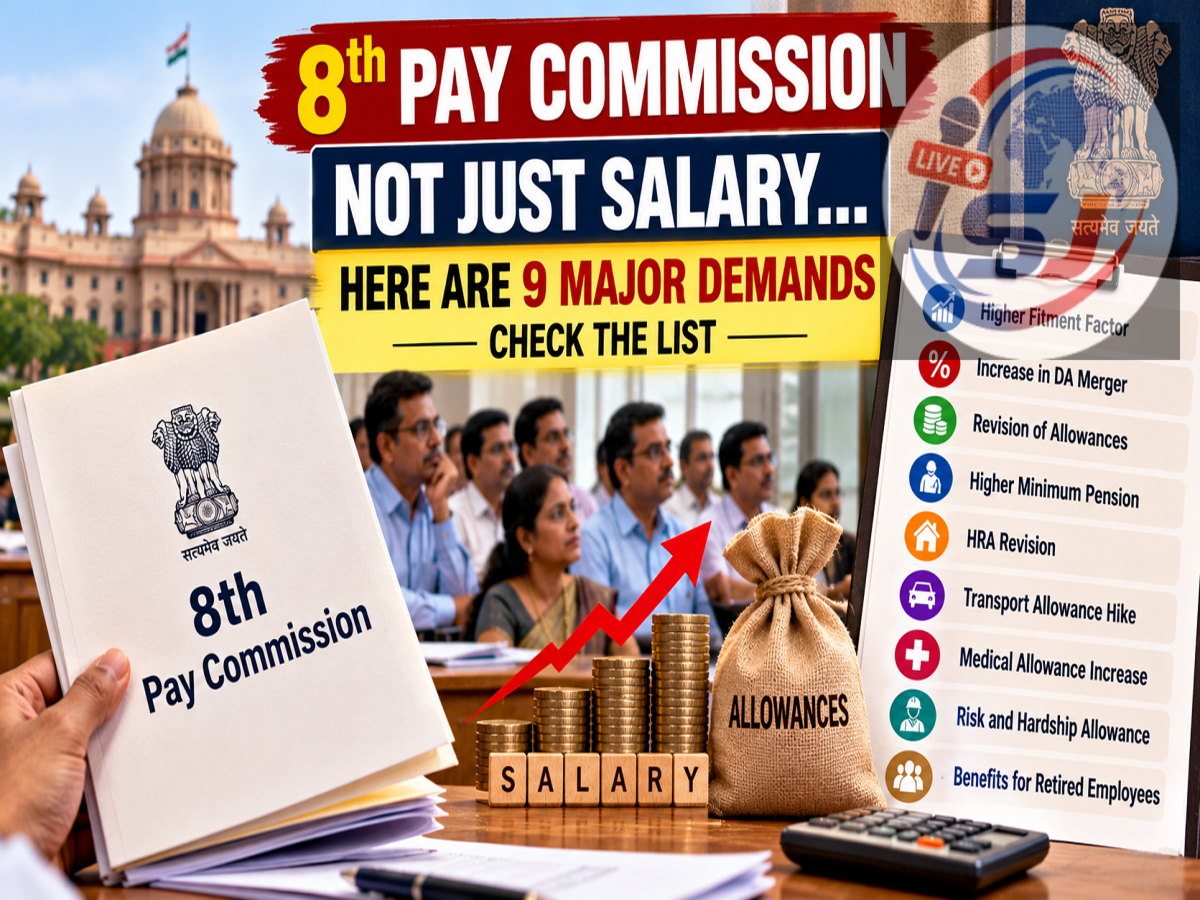
Discussions around the 8th Pay Commission are not limited to a possible increase in the salaries of central government employees. Employee and pensioner organisations are also raising a broader set of demands covering pensions, medical facilities, children's education, career progression, gratuity, family pension and allowances linked to difficult or risky working conditions.
According to the information provided in the report, organisations representing employees and pensioners have placed several key issues for consideration in connection with the 8th Pay Commission.
Among the prominent demands are restoration of the Old Pension Scheme (OPS), better cashless medical facilities, higher education-related allowances, improvements in gratuity and family pension provisions, changes to the Modified Assured Career Progression (MACP) system and enhanced risk-related allowances.
However, employees should keep an important distinction in mind: these are demands and proposals, not final benefits approved by the government.
The eventual recommendations and government decisions may differ.
8th Pay Commission Discussion Goes Beyond Basic Salary
Whenever a new Pay Commission is discussed, attention usually turns first to basic pay, pension and the fitment factor.
For employees, however, compensation includes much more than basic salary.
Allowances, career progression, retirement benefits, medical facilities and family protection can have a major impact on a government employee's overall financial position.
That is why employee organisations are seeking changes across multiple areas rather than focusing exclusively on salary revision.
Here are nine broad demands highlighted in the discussion.
1. Demand for Restoration of Old Pension Scheme
One of the most prominent issues is the demand to restore the Old Pension Scheme, commonly known as OPS.
Employee organisations have repeatedly raised pension security as a major concern and want the issue to be considered as part of the broader discussion surrounding the next pay revision.
The demand is particularly significant for employees who compare post-retirement benefits under different pension frameworks.
However, a demand for OPS restoration should not be interpreted as confirmation that the government has decided to bring back the old system.
Any such change would require a separate policy decision and official notification.
2. Better Cashless Medical Treatment
Medical coverage is another major area highlighted by employee and pensioner organisations.
The demand is for stronger and more accessible cashless healthcare facilities, particularly so that serving employees and retired personnel can receive treatment without having to arrange large amounts of money upfront.
Medical expenses can become a major financial burden, especially after retirement.
Employee groups therefore want improvements in the healthcare framework to be considered alongside salary and pension revisions.
The final structure, eligibility and network of healthcare facilities would depend on any recommendations accepted by the government.
3. Higher Children's Education Allowance
Rising education costs are another concern.
Employee organisations are seeking an improvement in allowances associated with children's education so that the benefit better reflects present-day school and education expenses.
Children's Education Allowance forms an important part of the overall benefits available to eligible central government employees.
The demand is that the next revision should account for the increase in education-related expenditure since the previous pay structure was implemented.
Again, no revised amount should be considered final until officially approved and notified.
4. Changes in the MACP System
The Modified Assured Career Progression (MACP) framework is another major issue.
MACP is intended to provide financial progression to eligible employees who may not receive regular promotions within prescribed periods.
Employee organisations are seeking changes to make the system more beneficial and address concerns related to career stagnation.
Changes to MACP could affect long-serving employees whose promotional opportunities are limited because of the structure of their department or cadre.
The precise modifications being considered will depend on representations, recommendations and the government's eventual decision.
5. Improvement in Gratuity Benefits
Gratuity is an important retirement-related benefit, and employee groups have also sought improvements in this area.
The demand reflects concerns that retirement benefits should keep pace with changes in salaries, inflation and the cost of living.
Any increase in gratuity limits or modification of gratuity calculations could have a meaningful financial impact on employees retiring under the revised pay framework.
However, the existing gratuity rules continue to apply unless and until changes are formally notified.
6. Better Family Pension Provisions
Family pension is designed to provide financial support to eligible family members following the death of a pensioner or government employee, subject to applicable rules.
Employee and pensioner organisations want improvements in the family pension framework to form part of the 8th Pay Commission discussion.
The objective behind the demand is to strengthen financial protection for dependants and surviving family members.
Details such as the rate of family pension, eligibility and duration of benefits will remain subject to the rules ultimately approved by the government.
7. Higher Risk and Hardship-Related Allowances
Some government employees work in conditions involving significant physical danger, difficult terrain or other occupational challenges.
Employee groups are therefore seeking better risk and hardship allowances for personnel serving under such circumstances.
The issue can be particularly relevant for jobs involving hazardous environments, remote locations or duties that expose employees to unusual levels of risk.
The applicable allowance would depend on the nature of employment and the classification of duties under government rules.
8. Review of Existing Allowances
Employee organisations also want the next pay revision to examine the wider allowance structure rather than simply changing basic pay.
Allowances can represent a substantial part of an employee's overall compensation.
Inflation and changes in living expenses since the implementation of the previous pay structure have led organisations to seek a comprehensive review of benefits associated with employment.
Any revision could ultimately differ by department, posting, employee category and eligibility conditions.
9. Stronger Retirement and Social-Security Benefits
The broader set of demands also focuses on improving long-term financial security for employees and pensioners.
Pension arrangements, gratuity, medical support and family benefits are all connected to the financial security available after an employee leaves active service.
Employee organisations therefore want the 8th Pay Commission process to look beyond monthly salary and consider the overall social-security framework available to government personnel and their families.
Are These 9 Benefits Already Approved?
No.
This is the most important point for central government employees and pensioners following developments around the 8th Pay Commission.
The issues discussed above represent demands being raised by employee and pensioner organisations. They should not be presented as benefits that have already been accepted or approved by the government.
A demand placed before a commission can be considered, modified, rejected or recommended in a different form.
Even after recommendations are made, the government's final decision determines which changes actually become applicable.
What About the 8th Pay Commission Fitment Factor?
The fitment factor remains one of the most closely watched subjects because of its potential impact on revised basic pay.
Several figures have circulated in reports and discussions, but speculative numbers should not be confused with an officially approved fitment factor.
Until an authoritative decision is announced, calculations showing a particular salary increase based on an assumed fitment factor remain estimates.
The same caution applies to claims about the exact revised minimum salary or pension.
Employees Should Watch Official Announcements
The 8th Pay Commission could eventually affect a wide range of financial benefits for central government employees and pensioners, but the process involves more than simply multiplying the current basic salary by a new factor.
Pension arrangements, healthcare, education allowances, career progression, gratuity, family pension and risk-related benefits are among the issues employee organisations want examined.
For now, however, these should be understood as representations and demands placed for consideration.
The final impact on employees will become clear only when recommendations are formally made, the government takes decisions on them and the approved changes are officially notified.
Until then, employees and pensioners should be cautious about reports presenting demands for OPS restoration, new allowance amounts or specific fitment factors as already approved benefits.