
8th Pay Commission Arrears: How Delay Could Affect Dues for Level 6, 7 and 8 Employees
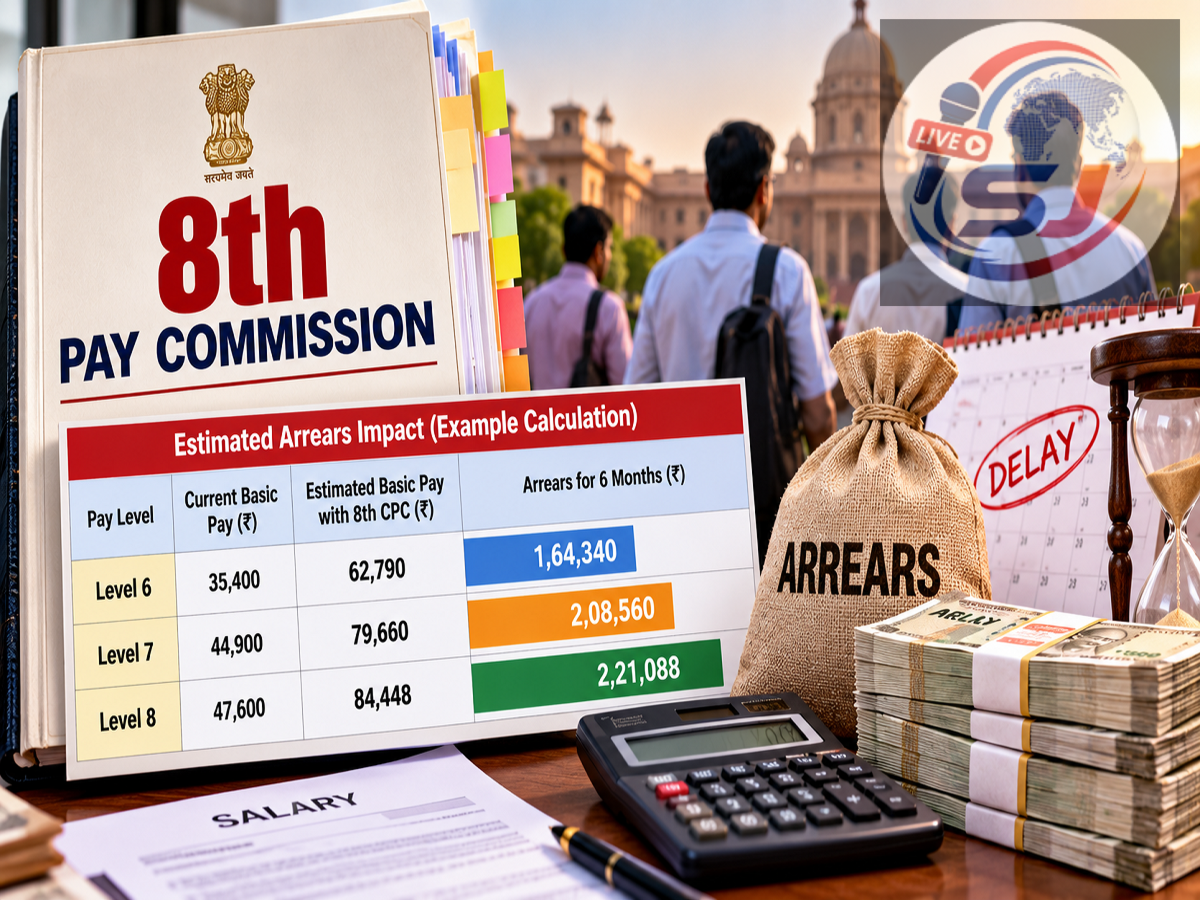
8th Pay Commission Arrears Calculation 2026: The wait for the 8th Central Pay Commission has raised an important question among central government employees: if the revised salary structure is implemented after a delay but given effect from an earlier date, how much could employees receive as arrears?
The answer will ultimately depend on several variables. An employee's existing Basic Pay, Pay Matrix level, the fitment methodology finally approved, the effective date of the revised pay structure and the number of months between that date and actual implementation could all influence the calculation.
Therefore, no fixed arrears amount can currently be treated as final.
Any calculation circulating before the government approves the revised pay structure should be viewed as an illustration based on assumptions, rather than a guaranteed payment.
Why Could a Delay Result in Arrears?
Arrears become relevant when a revised salary is made effective retrospectively but employees begin receiving the higher amount at a later date.
For example, suppose a revised pay structure is eventually made effective from an earlier date, but the revised salary reaches employees several months later.
If the government decides that employees are entitled to the difference for those intervening months, the unpaid difference can be settled as arrears.
In simplified terms:
Monthly arrears = Revised eligible salary − Salary already received
The monthly difference can then be multiplied by the number of months for which retrospective payment is approved.
The actual calculation, however, can be considerably more complicated because salary includes Basic Pay and potentially several eligible allowances.
Why the Fitment Factor Matters
The fitment factor is one of the most discussed aspects of the 8th Pay Commission.
In simple terms, it can be used as part of the process for converting existing Basic Pay into a revised pay structure.
For illustration, if an employee currently has Basic Pay of ₹50,000 and a hypothetical calculation results in revised Basic Pay of ₹75,000, the monthly Basic Pay difference would be:
₹75,000 − ₹50,000 = ₹25,000
If this difference were payable for 12 months, the simplified Basic Pay arrears would be:
₹25,000 × 12 = ₹3,00,000
This does not mean an employee earning ₹50,000 will actually receive ₹3 lakh in arrears. The example only demonstrates how retrospective salary differences can accumulate.
The final figure cannot be known until the government approves the relevant pay-revision formula and effective date.
Level 6 Employees: How Could Arrears Be Calculated?
Employees at Level 6 of the Pay Matrix can have different Basic Pay depending on their position within that level.
Consider a hypothetical Level 6 employee with current Basic Pay of ₹40,000.
Suppose, purely for calculation purposes, the eventual revision raises the relevant Basic Pay to ₹60,000.
The difference would be:
₹60,000 − ₹40,000 = ₹20,000 per month
If retrospective payment were approved for six months:
₹20,000 × 6 = ₹1,20,000
For 12 months:
₹20,000 × 12 = ₹2,40,000
For 18 months:
₹20,000 × 18 = ₹3,60,000
These numbers are examples only. They are not an official Level 6 arrears estimate.
Level 7 Employees: Higher Basic Pay Can Change the Amount
Now consider an illustrative Level 7 employee whose existing Basic Pay is ₹50,000.
Assume the revised Basic Pay under a hypothetical formula becomes ₹75,000.
The monthly difference would be ₹25,000.
| Delay Period | Illustrative Basic Pay Difference | Illustrative Arrears |
|---|---|---|
| 6 months | ₹25,000/month | ₹1,50,000 |
| 12 months | ₹25,000/month | ₹3,00,000 |
| 18 months | ₹25,000/month | ₹4,50,000 |
Again, these figures are designed only to explain the mathematics.
Actual arrears could be higher, lower or structured differently depending on the final government decision.
Level 8 Employees: How the Same Formula Works
Suppose a Level 8 employee has an existing Basic Pay of ₹60,000 and the revised Basic Pay under an assumed formula works out to ₹90,000.
The difference would be:
₹90,000 − ₹60,000 = ₹30,000 per month
If payable for six months, that would produce a simplified Basic Pay difference of ₹1.80 lakh.
For 12 months, it would become ₹3.60 lakh, while 18 months would produce ₹5.40 lakh.
These figures should not be read as an official projection for Level 8 employees. They merely demonstrate why employees with different Basic Pay can end up with significantly different arrears even when the retrospective period is identical.
Illustrative Comparison for Levels 6, 7 and 8
Using the hypothetical figures above, the difference becomes easier to understand:
| Pay Level | Assumed Existing Basic | Assumed Revised Basic | Monthly Difference | 12-Month Illustration |
|---|---|---|---|---|
| Level 6 | ₹40,000 | ₹60,000 | ₹20,000 | ₹2,40,000 |
| Level 7 | ₹50,000 | ₹75,000 | ₹25,000 | ₹3,00,000 |
| Level 8 | ₹60,000 | ₹90,000 | ₹30,000 | ₹3,60,000 |
None of these revised Basic Pay amounts has been presented here as an officially approved 8th CPC figure.
They are hypothetical values used solely to explain how arrears calculations work.
DA and Allowances Can Change the Final Calculation
Basic Pay alone may not tell the complete story.
Dearness Allowance, House Rent Allowance, Transport Allowance and other eligible components can affect an employee's total remuneration.
The treatment of these components after implementation of a new Pay Commission will therefore matter.
For example, the treatment of existing DA when moving to a revised Basic Pay structure could materially change the difference between old and new salary.
Similarly, allowances may be revised separately or become applicable from different dates.
That means simply multiplying existing Basic Pay by a speculative fitment factor is not enough to determine an employee's final salary or arrears.
Longer Delay Does Not Automatically Guarantee Larger Arrears
It may seem logical that every additional month of delay automatically adds another month's salary difference to arrears. However, that assumption is valid only if the government eventually approves retrospective implementation covering the entire period.
A delay in submitting or implementing the Pay Commission recommendations does not, by itself, create a legal guarantee of arrears.
The final government implementation order will be crucial.
It will determine the effective date, revised pay structure and whether the salary difference for the intervening period is payable.
Don't Treat Viral Fitment Factor Figures as Final
Several possible fitment factors have been discussed in media reports, employee-group demands and online calculations.
These figures can produce dramatically different revised Basic Pay and arrears estimates.
For example, even a relatively small difference in the assumed fitment factor can produce a substantial difference when applied across 12, 18 or more months.
Employees should therefore distinguish between an officially approved fitment factor, an employee union's demand, an expert estimate and a figure used by an online calculator.
Until the government takes a final decision, speculative calculations cannot establish an employee's actual entitlement.
What Will Decide the Final 8th CPC Arrears?
The eventual amount could depend on the employee's Pay Matrix level, existing Basic Pay, approved revised Basic Pay, effective date, actual implementation date, treatment of DA and other allowances, and any specific arrears instructions issued by the government.
This is why two employees at Level 7, for example, may not necessarily receive identical arrears.
Their Basic Pay, increment position, eligible allowances and other service-related factors can differ.
What Should Central Government Employees Watch Now?
Instead of relying on viral arrears calculators promising a specific amount, employees should watch for three major official developments: the 8th Pay Commission's recommendations, the government's decision on the revised pay structure, and the effective date specified in the final implementation order.
Only after these details are available will it be possible to calculate arrears with reasonable accuracy.
If revised pay is eventually granted retrospectively, the broad calculation would involve finding the difference between what an employee was entitled to receive under the new structure and what was actually paid during the relevant period.
Until then, calculations for Level 6, Level 7 or Level 8 employees should be treated as examples rather than guaranteed payouts.
Note: The figures used above are hypothetical and are intended only to explain the arrears calculation method. They are not official 8th Pay Commission salary, fitment factor or arrears figures.