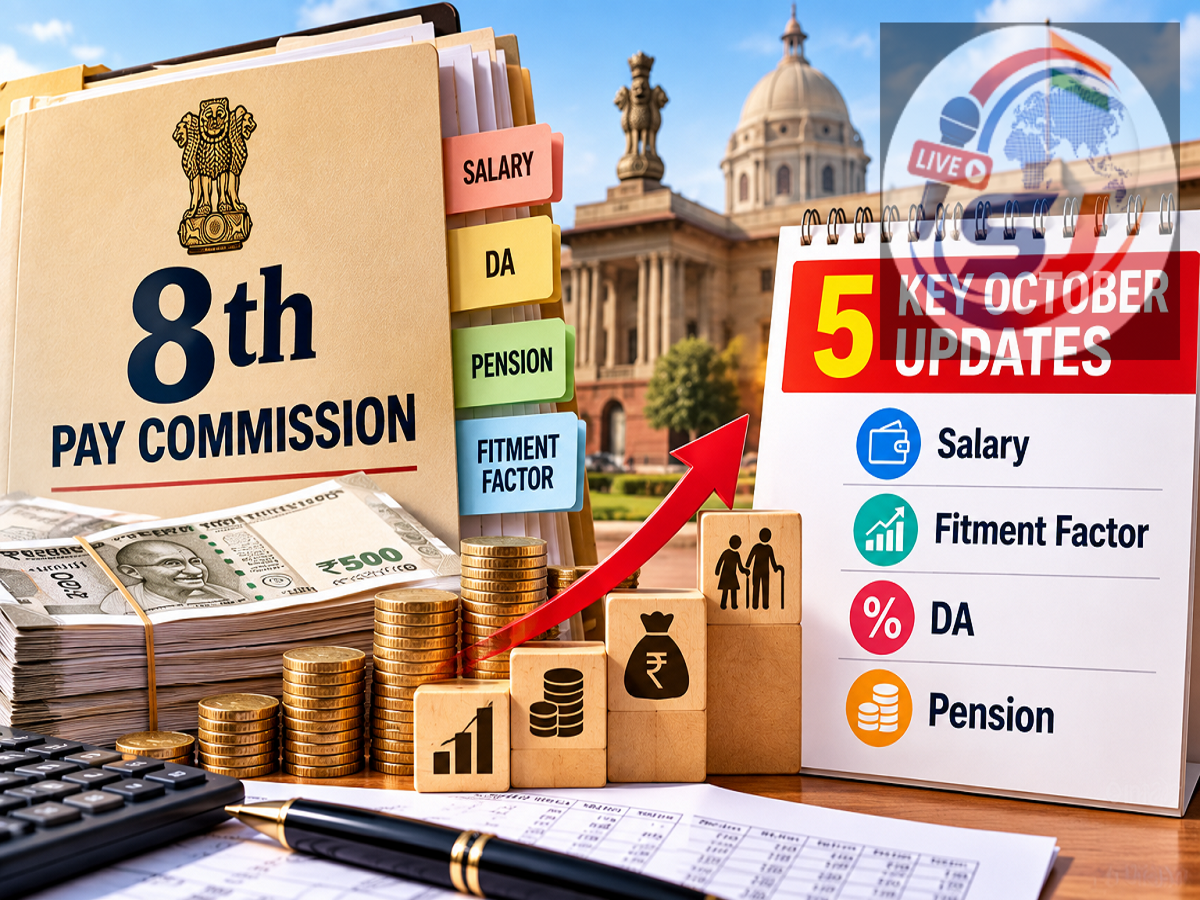
8th Pay Commission: 5 Key October Updates on Salary, Fitment Factor, DA and Pension
8th Pay Commission Latest Update: Central government employees and pensioners are closely following developments around the 8th Central Pay Commission as its consultation process moves forward. As of October 1, 2026, attention is focused on upcoming meetings, employee-union proposals on minimum basic pay and the fitment factor, the pending Dearness Allowance revision, and the timeline for the Commission's final recommendations.
The 8th Central Pay Commission was formally constituted through a government notification dated November 3, 2025, and has been given 18 months to submit its recommendations.
However, employees should distinguish between confirmed developments and demands made by staff organisations. No final fitment factor, revised minimum salary or new pension structure has yet been announced.
Here are five major developments to know as October begins.
1. 8th Pay Commission Meetings Scheduled in Bengaluru and Mumbai
October will be an important month for the Commission's stakeholder consultations.
According to the official 8th Central Pay Commission website, the panel is scheduled to visit Bengaluru on October 7 and 8, 2026, followed by a visit to Mumbai on October 22 and 23, 2026.
These visits are part of the Commission's consultation process with organisations, institutions, associations and unions representing central government employees and other stakeholders.
Issues relating to salaries, allowances, pensions, service conditions and other employee benefits are expected to feature in the wider consultation process.
The meetings are significant because the Commission is gathering stakeholder views before finalising its recommendations. However, the meetings themselves should not be interpreted as confirmation that any particular salary increase or fitment factor has been approved.
2. October 10 Is an Important Deadline for the Mumbai Visit
Employee and pensioner organisations interested in interacting with the Commission during its Mumbai visit should also note an important date.
The official Commission website lists October 10, 2026, as the last date connected with requests for appointments for the Mumbai visit scheduled for October 22-23.
For the Bengaluru meetings, the deadline for appointment requests was September 18.
The consultation process gives recognised stakeholders an opportunity to present their concerns and proposals. These submissions may cover areas such as basic pay, pension, allowances, annual increments and other service-related benefits.
3. DA Revision Is Awaited, but Final Rate Needs Official Confirmation
Dearness Allowance is another major issue being watched by central government employees.
The existing DA rate is 60%, following the January 2026 revision. The next revision is due from July 1, 2026, but an official announcement is awaited.
Earlier calculations based on available inflation data had pointed towards the possibility of a three-percentage-point increase to 63%. However, newer CPI-IW data have produced different estimates, so employees should not treat 63% as the officially confirmed DA rate unless and until the government announces the revision.
The DA/DR revision is separate from the 8th Pay Commission's eventual recommendations, although both developments are important for employees and pensioners.
4. ₹69,000 Minimum Basic Pay and 3.833 Fitment Factor Are Demands, Not Final Decisions
One of the most discussed figures surrounding the 8th Pay Commission is a 3.833 fitment factor.
The Staff Side of the National Council-JCM has proposed a minimum basic pay of ₹69,000, compared with the existing ₹18,000 minimum under the 7th Pay Commission structure. Based on that proposed minimum, the Staff Side has sought a fitment factor of 3.833.
Another major demand is to increase the annual increment from the existing 3% to 6%.
These figures could have a substantial impact on salary calculations if accepted. For example, ₹69,000 would represent a significant increase over the existing ₹18,000 minimum basic pay.
But there is an important distinction: ₹69,000 and 3.833 are proposals submitted by employee representatives. They have not been approved by the 8th Pay Commission or the central government.
The Commission can accept, modify or reject proposals received from stakeholders before making its recommendations.
5. When Could the 8th Pay Commission Report Be Submitted?
The official timeline provides more clarity than many salary projections circulating online.
The Commission was constituted on November 3, 2025 and has been given 18 months to submit its recommendations. This places the expected completion of its mandated period around May 2027.
The Union Cabinet's Terms of Reference also state that the Commission may submit interim reports if it considers them necessary.
What happens after the recommendations are submitted will depend on the government's consideration and subsequent notification.
The government previously said that, following the usual 10-year Pay Commission cycle, the effect of the 8th CPC recommendations would normally be expected from January 1, 2026.
However, employees should be careful about treating reports of a guaranteed arrears payment from January 1, 2026 as already finalised. The precise implementation mechanism, accepted recommendations and treatment of arrears will depend on the government's eventual decision.
How Much Could Salaries Increase Under the 8th Pay Commission?
There is currently no officially approved percentage by which salaries will rise.
The eventual increase will depend on several factors, including the basic-pay structure recommended by the Commission, the fitment formula accepted by the government, changes to the pay matrix and the treatment of allowances.
The widely discussed 3.833 fitment factor represents the Staff Side's demand rather than an approved multiplier.
Similarly, the proposed ₹69,000 minimum basic salary should not be presented as the salary employees are certain to receive under the 8th Pay Commission.
What Should Employees Watch Next?
October 2026 could provide more insight into the direction of the consultation process, particularly with the Commission's scheduled visits to Bengaluru and Mumbai.
Central government employees and pensioners should watch for official announcements regarding the pending DA/DR revision as well as updates published by the 8th Central Pay Commission following stakeholder consultations.
For now, the most important distinction is between confirmed developments and employee-body demands. The Commission is operational, its October consultations are scheduled and its 18-month mandate is confirmed. But the final fitment factor, revised minimum basic salary, pension formula and exact implementation arrangements remain undecided.
Until the Commission submits its recommendations and the government takes a formal decision, salary figures based on fitment factors such as 3.833 should be treated as proposals and illustrative calculations rather than guaranteed increases.