
8th Pay Commission 2026: ₹69,000 Minimum Basic Salary and ₹34,000 Pension Demanded, Check Latest Proposal
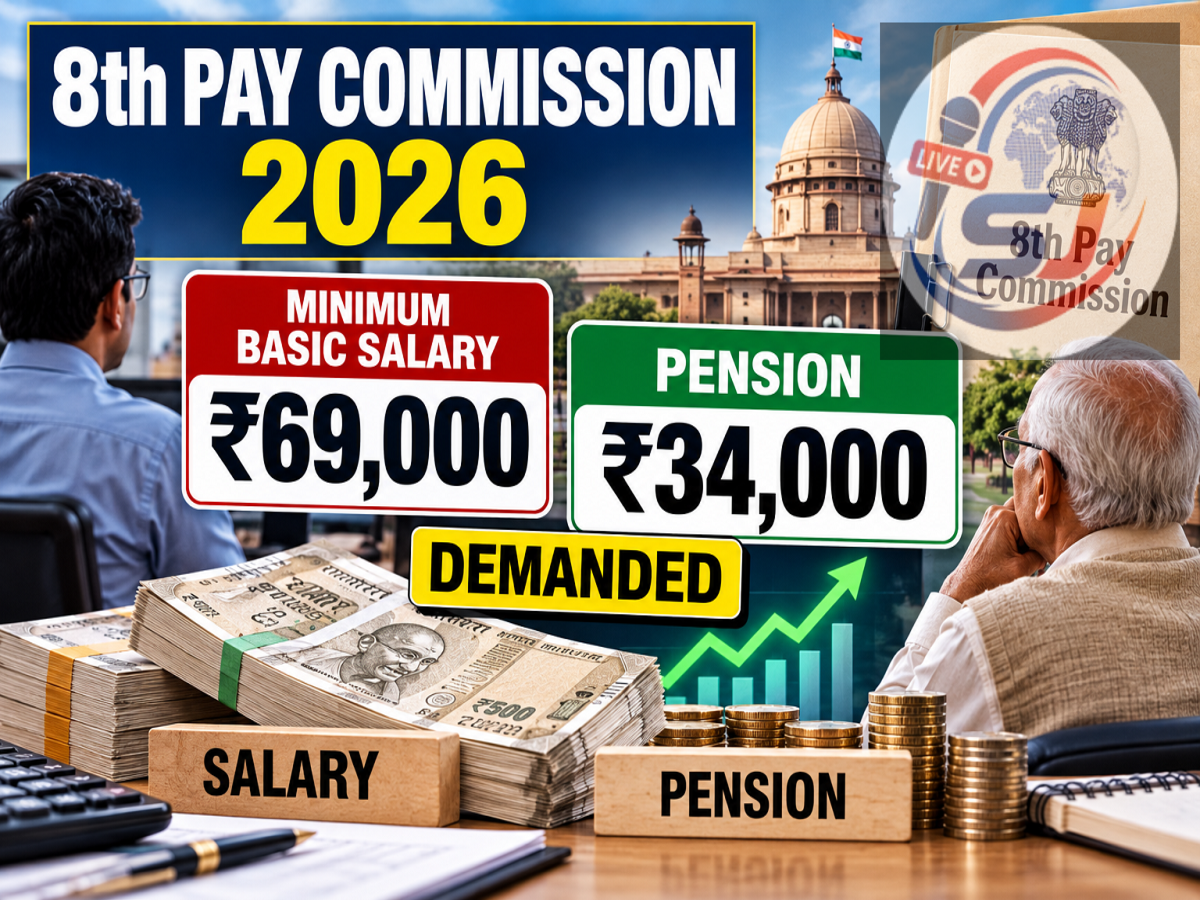
8th Pay Commission Latest Update: Central government employees and pensioners are closely watching developments related to the 8th Central Pay Commission. A fresh proposal from a pensioners' organisation in Bengaluru has brought renewed attention to possible increases in basic salaries, pensions, and annual increments.
According to a report published on October 11, 2026, the pensioners' body has demanded a substantial revision in the existing pay structure. Its recommendations reportedly include a fitment factor of 3.833, a minimum basic salary of approximately ₹69,000, and a minimum basic pension of around ₹34,500 per month.
The organisation has also suggested revising the method used to calculate minimum wages by increasing the number of family consumption units considered in salary calculations.
These demands have generated interest among central government employees who are awaiting the next pay revision.
However, the proposed salary and pension figures are not officially approved amounts. They represent recommendations submitted by a pensioners' organisation and remain subject to examination by the Pay Commission and the central government.
8th Pay Commission: What Is the Latest Update?
The latest development concerns demands reportedly presented by pensioners' representatives in Bengaluru.
According to the supplied report, the organisation believes that the existing salary and pension structure should be revised to reflect rising household expenses and changing economic conditions.
The recommendations focus on improving the financial position of serving employees as well as retired government personnel.
The major proposals include a higher fitment factor, an increase in minimum basic pay, a substantial pension revision, and changes to the calculation of family-related expenses.
The organisation has also raised the issue of annual increments and the structure of the existing pay matrix.
These suggestions are part of the broader discussions surrounding the 8th Pay Commission. They do not mean that the government has already accepted the demands.
Minimum Basic Salary Could Reach ₹69,000 Under Proposed Fitment Factor
One of the most significant demands is to introduce a fitment factor of 3.833.
A fitment factor is a multiplier used to determine revised basic pay under a new salary structure.
Under the 7th Central Pay Commission, the minimum basic salary is ₹18,000 per month.
Applying the suggested fitment factor produces the following calculation:
₹18,000 × 3.833 = ₹68,994
After rounding, the proposed minimum basic salary would be approximately ₹69,000.
| Salary Component |
Amount |
|---|---|
| Existing minimum basic pay |
₹18,000 |
| Proposed fitment factor |
3.833 |
| Calculated revised basic pay |
₹68,994 |
| Rounded proposed minimum basic pay |
₹69,000 |
| Increase in basic pay |
Approximately ₹51,000 |
This would represent a major increase in the minimum basic pay figure.
However, employees should not assume that their take-home salary would rise by the same proportion.
The actual salary revision would depend on the approved fitment factor, Dearness Allowance treatment, House Rent Allowance, Transport Allowance, and other applicable rules.
8th Pay Commission Pension Hike: Minimum Pension of Around ₹34,500 Proposed
The pensioners' organisation has also demanded a substantial increase in the minimum basic pension.
Under the existing 7th Pay Commission framework, the minimum basic pension is ₹9,000 per month.
If the proposed fitment factor of 3.833 were applied directly, the calculation would be:
₹9,000 × 3.833 = ₹34,497
This produces an illustrative revised basic pension of approximately ₹34,500.
Some reports describe the demand as a pension increase to around ₹34,000 or ₹34,470.
The precise amount would depend on the calculation and rounding method adopted in any final recommendations.
| Pension Details |
Amount |
|---|---|
| Existing minimum basic pension |
₹9,000 |
| Proposed fitment factor |
3.833 |
| Illustrative revised basic pension |
₹34,497 |
| Approximate monthly increase |
₹25,497 |
It is important to distinguish between basic pension and the total pension received after adding applicable Dearness Relief and other benefits.
The proposed amount is not a confirmed pension payment.
Why Are Pensioners Demanding Such a Large Increase?
The pensioners' organisation reportedly argues that minimum salaries and pensions should reflect the financial needs of modern households.
Expenses related to food, housing, healthcare, transportation, education, and communication have changed considerably over the years.
The organisation believes that the method used to calculate minimum wages should account for these developments.
Its recommendations also reflect concerns about the financial responsibilities of employees who support dependent family members, including elderly parents.
However, any major salary revision would have implications for government expenditure.
The Commission would therefore need to evaluate affordability, wage principles, and the wider economic impact before making recommendations.
Family Units Could Increase From Three to Five
Another important proposal concerns the number of family consumption units used when calculating minimum wages.
The pensioners' organisation has reportedly demanded that the existing three-unit approach be replaced with a calculation based on approximately five units.
The proposed structure includes the employee, spouse, children, and dependent parents.
| Family Member |
Proposed Consumption Units |
|---|---|
| Employee |
1.0 |
| Spouse |
1.0 |
| Two children |
1.6 |
| Two parents |
1.6 |
| Total |
5.2 |
The organisation has suggested using approximately five units for minimum wage calculations.
The argument is that modern households may have financial responsibilities extending beyond a smaller family structure.
Including more dependants in the calculation could increase the estimated minimum amount required to support a household.
However, this remains a proposal and has not become an approved government salary calculation rule.
Demand to Revise the Aykroyd Formula
The pensioners' body has also called for a review of the principles used to determine minimum wages.
The Aykroyd Formula has historically influenced minimum wage calculations in India, particularly through the framework associated with the 1957 Indian Labour Conference.
The organisation reportedly believes that wage calculations should be updated to account for present-day expenses.
For example, internet connectivity, mobile phones, and digital devices have become important for education, communication, and everyday activities.
Healthcare and other household costs are also important considerations.
The proposed changes aim to make minimum wage calculations more representative of contemporary living requirements.
Annual Increment May Also Be Revised if Demand Is Accepted
Apart from the fitment factor and minimum salary, pensioners' representatives have reportedly supported increasing the annual increment rate from 3% to 6%.
An annual increment affects how an employee's basic pay progresses over time.
For illustration, consider a basic salary of ₹69,000.
A simple 3% increase would amount to ₹2,070, while a 6% increase would amount to ₹4,140.
| Increment Rate |
Illustrative Annual Increase on ₹69,000 |
|---|---|
| 3% |
₹2,070 |
| 6% |
₹4,140 |
These figures are mathematical examples. Actual increments under a government pay matrix are governed by prescribed pay cells and applicable service rules.
No official decision approving a 6% annual increment has been established by the supplied report.
Will Employees Really Receive Three Times Their Current Salary?
The proposed fitment factor of 3.833 could make revised basic pay approximately 3.83 times the existing basic pay.
However, this does not mean employees would receive 3.83 times their current total salary.
Existing salary packages generally include basic pay, Dearness Allowance, House Rent Allowance, and other eligible allowances.
When a new pay commission's recommendations are implemented, the treatment of existing DA and the calculation of revised allowances can affect the final salary.
For example, comparing ₹69,000 only with the existing ₹18,000 basic pay does not account for the DA already received under the current structure.
The actual percentage increase in total monthly earnings would therefore require a separate calculation using the officially approved rules.
When Will the 8th Pay Commission Salary Hike Be Confirmed?
Employees and pensioners will need to wait for the Commission's recommendations and the government's subsequent decisions.
Different employee and pensioner organisations may submit different fitment factor demands and salary proposals.
The Commission must examine these representations before preparing its recommendations.
The central government would then determine which recommendations to accept and how any approved changes should be implemented.
Until an official announcement is made, claims regarding a final fitment factor, minimum salary, pension amount, or arrears should be treated cautiously.
8th Pay Commission Latest News: What Should Employees Know?
The latest reported proposal from Bengaluru has renewed discussion about the next salary and pension revision for central government employees.
The pensioners' organisation has demanded a fitment factor of 3.833, which would produce an illustrative minimum basic salary of approximately ₹69,000 and a minimum basic pension of around ₹34,500.
It has also called for changes to family consumption units, minimum wage calculations, and annual increments.
The most important point is that these are demands, not approved 8th Pay Commission recommendations or government notifications.
Employees and pensioners should rely on official announcements before making financial decisions based on projected salary or pension increases.
Disclaimer: This article is based on the supplied October 11, 2026 report and related proposal details. The figures are illustrative demands attributed to a pensioners' organisation and have not been independently verified against official Commission records.