
8th Pay Commission 2026: Will Minimum Pension Rise to ₹45,000? Pensioners Demand 67% Pension and Higher Benefits
8th Pay Commission Latest Update 2026: The 8th Central Pay Commission continues to attract significant attention among central government employees and pensioners. While serving employees are looking forward to possible salary revisions, retired government personnel are seeking substantial improvements in pension benefits.
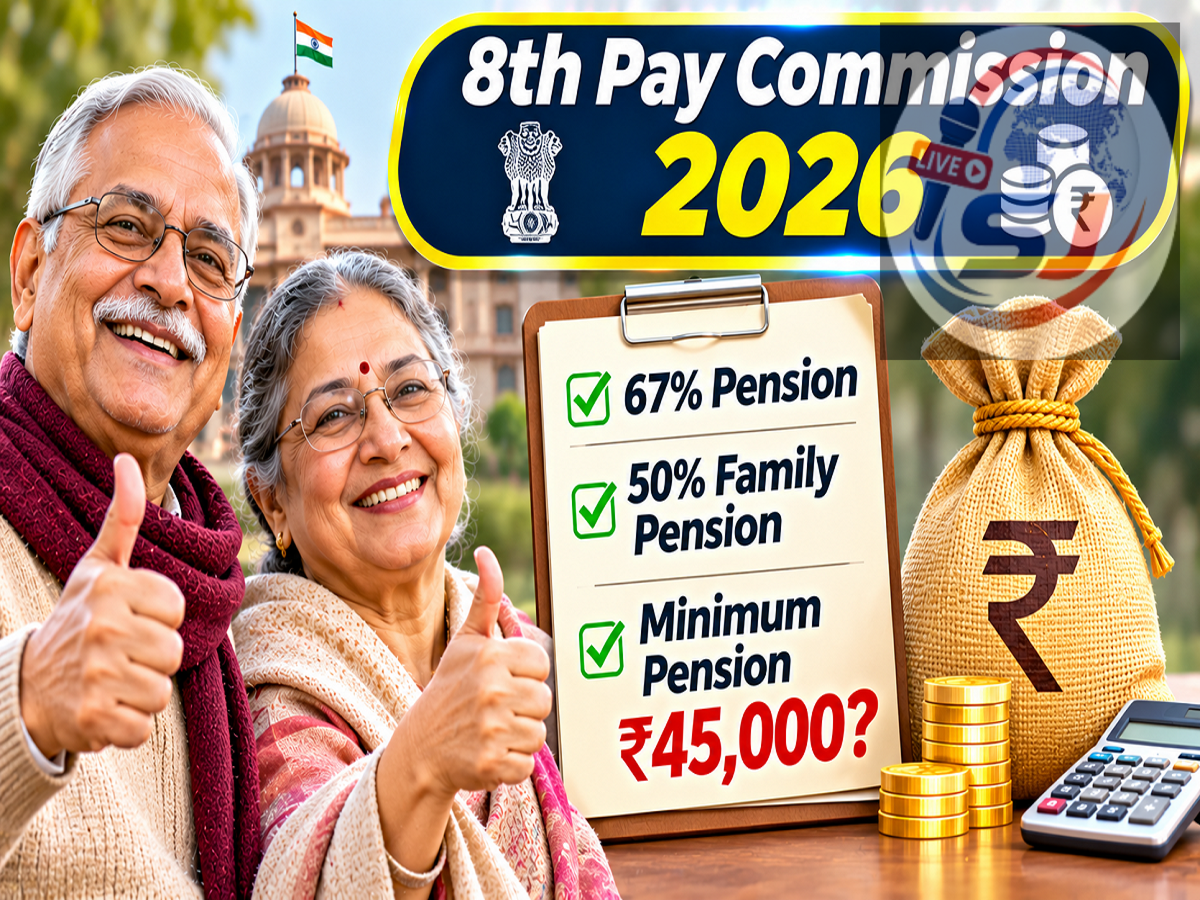
According to recent reports, pensioners' organizations have submitted several important demands to the commission, including increasing the basic pension rate from 50% to 67% of the last drawn basic salary.
Another major proposal is to raise the minimum monthly pension to ₹45,000. Pensioners' representatives have also demanded an increase in the ordinary family pension rate from 30% to 50%.
If these recommendations are eventually accepted, they could significantly change retirement benefits for eligible central government pensioners.
However, the proposed ₹45,000 minimum pension and 67% pension rate have not been approved by the Central Government. They remain demands submitted for consideration under the 8th Pay Commission process.
8th Pay Commission: What Is the Latest Development?
The Central Government established the 8th Central Pay Commission in November 2025 to examine the salary structure, allowances and other service-related benefits of eligible central government employees.
The commission is also expected to consider pension-related matters within its terms of reference.
As part of the consultation process, employee associations and pensioners' organizations have been presenting their demands and recommendations.
These representations include proposals concerning pension calculation, minimum retirement benefits, family pensions, annual increments and salary revision.
The commission will evaluate relevant submissions before preparing its recommendations.
The Central Government will then examine the report and decide which recommendations, if any, should be implemented.
When Will the 8th Pay Commission Submit Its Report?
The 8th Central Pay Commission was constituted on November 3, 2025.
It was given approximately 18 months to submit its recommendations.
Based on this timeline, the report may be submitted around May 2027, although the actual submission date will depend on the commission's work and any subsequent official decisions.
Once the report is submitted, the government will review its recommendations.
The implementation process may involve further examination of financial implications, administrative requirements and other relevant considerations.
Therefore, the submission of the report should not be confused with the immediate implementation of revised salaries or pensions.
Pensioners Demand 67% Basic Pension Instead of 50%
One of the most significant demands concerns the calculation of basic pension.
Under the existing framework applicable to many eligible central government retirees under the traditional pension system, basic pension is generally calculated at 50% of the last drawn basic pay or the relevant average emoluments, subject to applicable rules.
Pensioners' organizations have proposed increasing the rate to 67%.
They argue that higher pension benefits would help retired employees manage rising living expenses and maintain financial security.
If the proposal is accepted, eligible pensioners could receive a higher basic pension.
However, the actual impact would depend on the final rules, including the revised pension calculation method and applicability to different categories of retirees.
How Much Could Pension Increase Under the 67% Proposal?
Consider a hypothetical retired employee whose last drawn basic salary was ₹44,900.
Under a simple calculation using a 50% pension rate, the basic pension would be ₹22,450.
If the pension rate were increased to 67% of the same basic salary, the resulting amount would be approximately ₹30,083.
Pension Calculation Example
| Pension calculation | Existing 50% rate | Proposed 67% rate |
|---|---|---|
| Last drawn basic salary | ₹44,900 | ₹44,900 |
| Basic pension percentage | 50% | 67% |
| Monthly basic pension | ₹22,450 | ₹30,083 |
| Monthly increase | — | ₹7,633 |
This example shows a potential increase of ₹7,633 per month in basic pension.
On an annual basis, the difference would be approximately ₹91,596.
However, this is only an illustrative calculation based on the proposed percentage.
It does not account for possible pay revisions, dearness relief, rounding rules or other adjustments.
It should not be interpreted as an officially approved pension increase.
Will the Minimum Pension Become ₹45,000?
Another major demand is to increase the minimum monthly pension to ₹45,000.
Pensioners' organizations have argued that existing minimum pension levels should be reviewed in light of changing living costs.
A higher minimum pension could provide additional financial support to eligible retirees receiving lower basic pensions.
However, the proposal has not yet been accepted by the Central Government.
The final minimum pension, if revised, will depend on the commission's recommendations and subsequent government approval.
Therefore, reports claiming that a ₹45,000 minimum pension has already been implemented are misleading.
Family Pension May Also See a Major Revision
Pensioners' representatives have also proposed increasing the ordinary family pension rate from 30% to 50%.
Family pension is an important financial support mechanism for eligible family members after the death of a government employee or pensioner.
Under the existing framework, ordinary family pension is generally calculated at 30% of the applicable pay or pensionable emoluments, subject to relevant provisions.
Enhanced family pension may apply in certain circumstances under separate rules.
The proposal to increase the ordinary rate to 50% is intended to improve financial support for eligible dependants.
Example of Proposed Family Pension Increase
If the relevant basic pay for calculation is ₹50,000, the difference would be:
| Particulars | Existing rate | Proposed rate |
|---|---|---|
| Basic pay used for illustration | ₹50,000 | ₹50,000 |
| Ordinary family pension rate | 30% | 50% |
| Monthly family pension | ₹15,000 | ₹25,000 |
| Difference | — | ₹10,000 |
The example is hypothetical and does not represent a sanctioned revision.
Actual family pension amounts depend on the applicable service and pension rules.
Three Major Demands of Pensioners' Organizations
| Demand | Existing general framework | Proposed change |
|---|---|---|
| Basic pension | Generally 50% of eligible pay | Increase to 67% |
| Minimum pension | Existing minimum under applicable rules | Increase to ₹45,000 per month |
| Ordinary family pension | Generally 30% of applicable pay | Increase to 50% |
All three demands remain under consideration and have not become final government policy.
What Are Central Government Employees Demanding?
Alongside pension-related proposals, employee associations have raised several demands concerning the salary structure.
These include a higher fitment factor and an increase in the annual increment rate.
Demand for a 3.833 Fitment Factor
Some employee organizations have reportedly proposed a fitment factor of 3.833.
A fitment factor is used in pay revision calculations to determine revised basic pay from the existing basic pay.
However, the fitment factor ultimately recommended by the commission may differ from the figure demanded by employee associations.
No final fitment factor has been officially approved under the 8th Pay Commission.
Demand to Increase Annual Increment to 6%
Employee organizations have also proposed raising the annual increment rate from the existing general level of 3% to 6%.
If such a proposal were accepted, it could change the progression of basic pay over time.
However, this remains a demand rather than an approved change.
Will Employees and Pensioners Receive Arrears From January 1, 2026?
There has been considerable discussion about January 1, 2026, as a possible effective date for revised salary and pension benefits.
Some reports suggest that employees and pensioners could become eligible for arrears if the government eventually approves revisions with retrospective effect from that date.
However, arrears from January 1, 2026, have not been guaranteed.
The effective date, implementation date and arrears arrangements will depend on future government decisions.
Even if revised benefits are made effective retrospectively, the actual payment process and eligible amounts would require separate official instructions.
Employees and pensioners should therefore avoid calculating expected arrears as confirmed income.
Will Every Pensioner Benefit From the Proposed Changes?
The impact of any future pension revision will depend on the category of pensioner and the applicable retirement scheme.
Central government employees and retirees may be covered by different arrangements, including the traditional pension framework, the National Pension System and other applicable schemes.
The proposed 67% basic pension formula should not automatically be assumed to apply to every retiree.
Similarly, employees of state governments, public sector organizations and other institutions may be governed by separate rules.
The final scope of any changes will become clear only after official recommendations and government decisions are published.
What Should Pensioners Do Now?
Pensioners do not need to submit an application merely because an organization has demanded a higher pension rate.
At present, the important step is to monitor official announcements.
Retirees can review their existing pension documents, Pension Payment Order details and relevant records to ensure that their information is accurate.
They should also remain cautious about messages claiming that a pension increase has already been sanctioned or that a processing fee is required to receive revised benefits.
Any future revision should be verified through official government notifications and authorized pension-disbursing channels.
Conclusion
The 8th Central Pay Commission has generated considerable expectations among central government employees and pensioners.
The demands for a 67% basic pension rate, a ₹45,000 minimum monthly pension and a 50% ordinary family pension rate are among the most significant proposals currently being discussed.
Employee associations have also sought changes to the fitment factor and annual increment rate.
However, these proposals are not final government decisions.
The commission is expected to submit its recommendations around 2027, after which the Central Government will decide on implementation.
Until then, pensioners and employees should rely on official announcements rather than treating reported demands as confirmed benefits.
Disclaimer: The 67% pension rate, ₹45,000 minimum pension, 50% ordinary family pension, 3.833 fitment factor and 6% annual increment are reported demands, not approved government benefits. All calculations are illustrative and subject to official rules and future decisions.