
8th Pay Commission 2026: Pensioners Seek 67% Pension, 50% Family Pension and ₹45,000 Minimum
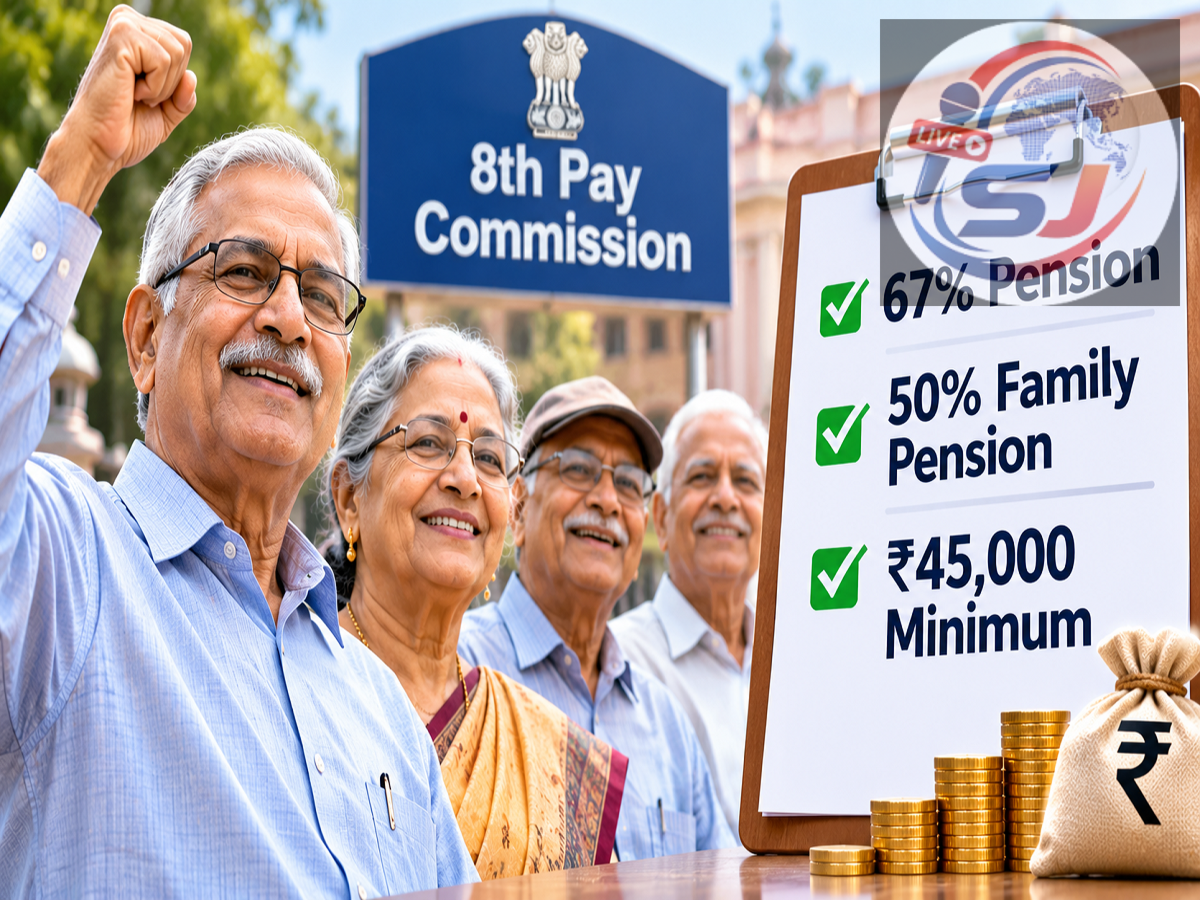
8th Pay Commission Latest News 2026: Central government pensioners could see a significant increase in their monthly retirement benefits if the demands submitted by pensioners' organisations are accepted under the 8th Central Pay Commission. Bharat Pensioners Samaj has reportedly proposed major changes to the existing pension structure, including raising regular pensions to 67% of the last drawn salary and increasing family pension benefits.
The organisation has also demanded that the minimum monthly pension be fixed at ₹45,000, a proposal that could substantially improve financial security for retired government employees and their families.
According to a report published by Aaj Tak on November 19, 2026, these proposals have been placed before the 8th Pay Commission for consideration.
However, the demands are currently proposals, not approved government decisions. Any revision in pension rates will depend on the commission's recommendations and the government's final approval.
Pensioners Demand 67% of Last Drawn Salary as Monthly Pension
One of the most significant demands concerns the calculation of regular pensions for retired central government employees.
Under the existing pension framework applicable to eligible employees covered by the old pension rules, pension is generally calculated at 50% of the last drawn basic pay or average emoluments, whichever is more beneficial, subject to applicable conditions.
Bharat Pensioners Samaj has reportedly requested that this percentage be increased to 67%.
If accepted, the proposal would provide eligible pensioners with a larger proportion of their final basic salary as retirement income.
For example, an employee retiring with a last drawn basic salary of ₹60,000 would receive a basic pension of ₹30,000 under a simple 50% calculation.
At the proposed 67% rate, the amount would increase to ₹40,200.
This would represent an additional ₹10,200 in monthly basic pension, excluding applicable dearness relief and other adjustments.
How Much Could Pensions Increase Under the 67% Proposal?
The following table illustrates the potential difference between the existing 50% pension calculation and the proposed 67% formula.
| Last Drawn Basic Pay |
Pension at 50% |
Pension at 67% |
Monthly Increase |
|---|---|---|---|
| ₹40,000 |
₹20,000 |
₹26,800 |
₹6,800 |
| ₹50,000 |
₹25,000 |
₹33,500 |
₹8,500 |
| ₹60,000 |
₹30,000 |
₹40,200 |
₹10,200 |
| ₹70,000 |
₹35,000 |
₹46,900 |
₹11,900 |
| ₹80,000 |
₹40,000 |
₹53,600 |
₹13,600 |
| ₹1,00,000 |
₹50,000 |
₹67,000 |
₹17,000 |
These figures are hypothetical calculations based on the reported 67% demand. They are not officially approved pension amounts. The proposed ₹45,000 minimum, if adopted, could also affect the final payable amounts.
Family Pension May Rise From 30% to 50%
Apart from seeking a higher regular pension, Bharat Pensioners Samaj has proposed increasing the standard family pension rate from 30% to 50% of the last drawn basic salary.
Family pension provides financial assistance to eligible dependants following the death of a government employee or pensioner.
Consider a government employee whose final basic salary was ₹44,900.
Under the standard 30% family pension formula, the monthly amount would be ₹13,470.
If the proposed 50% rate is approved, the family pension would increase to ₹22,450, representing an additional ₹8,980 per month.
The calculation excludes dearness relief and assumes the standard family pension rate rather than special enhanced-family-pension provisions.
Minimum Monthly Pension of ₹45,000 Also Proposed
Another major demand concerns the minimum pension payable to eligible retired central government employees.
Bharat Pensioners Samaj wants the minimum basic pension fixed at ₹45,000 per month under the 8th Pay Commission.
The proposed minimum is particularly important for pensioners who retired from lower-paying positions and currently receive relatively small basic pensions.
For example, a pensioner receiving ₹20,000 in monthly basic pension would see a substantial increase if a ₹45,000 minimum were introduced and applied to their category.
However, the ₹45,000 amount remains a demand. It is not the current minimum pension, and no government order has been issued approving it.
Level-6 Employees Could See Thousands More Every Month
The potential effect can be illustrated using the entry-level basic pay of ₹44,900 under Level 6 of the 7th Central Pay Commission pay matrix.
Illustrative pension calculation for ₹44,900 basic pay
Current 50% calculation
₹22,450
Per month
Proposed 67% calculation
₹30,083
Per month
Potential monthly increase
₹7,633
Illustrative percentage-based calculation, before dearness relief and without applying the separately proposed ₹45,000 minimum pension.
Over 12 months, the percentage-based increase would amount to ₹91,596.
If the minimum pension demand were also approved, the eventual calculation could differ considerably. The commission would need to clarify how the minimum pension and percentage-based pension formulas would operate together.
Upstox - Online Stock and Share Trading
Why Did the 7th Pay Commission Reject Similar Demands?
The demand to increase pension rates is not entirely new.
Pensioners' organisations had previously requested improvements in regular and family pension percentages during consultations for the 7th Central Pay Commission.
However, the commission did not recommend increasing the standard pension rate beyond 50% or the standard family pension rate beyond 30%.
Its reasoning included the improvements already introduced under earlier pay commissions and the fact that revised salary structures would also influence retirement benefits.
The 8th Pay Commission will now have to assess the renewed demands in light of present economic conditions, retirement expenses and the financial implications for the government.
When Will the 8th Pay Commission Pension Hike Be Implemented?
As of November 20, 2026, the proposed pension increases have not been approved.
The commission must examine representations from employees' and pensioners' organisations before preparing its recommendations.
The central government will subsequently decide which recommendations to accept and when approved revisions should take effect.
Therefore, pensioners should not treat the proposed 67% pension rate, 50% family pension rate or ₹45,000 minimum pension as confirmed benefits.
Conclusion
The latest demands submitted by Bharat Pensioners Samaj have brought renewed attention to retirement income under the 8th Central Pay Commission.
The organisation is seeking three major changes: regular pension at 67% of last drawn pay, standard family pension at 50% and a minimum monthly basic pension of ₹45,000.
If implemented, these proposals could substantially improve monthly retirement income for eligible central government pensioners and their families.
However, the final outcome will depend on the commission's recommendations, government approval and the detailed rules governing implementation.
Additional References: Aaj Tak Business Desk, November 19, 2026; Mint, November 19, 2026; and Upstox, November 18, 2026.
Disclaimer: All proposed pension figures are illustrative and do not represent approved government benefits. Actual pension revisions will depend on official recommendations, eligibility conditions and government notifications.