
8th Pay Commission 2026: Basic Salary May Reach ₹69,000, Check Proposed Pay Hikes for Levels 1, 6 and 18
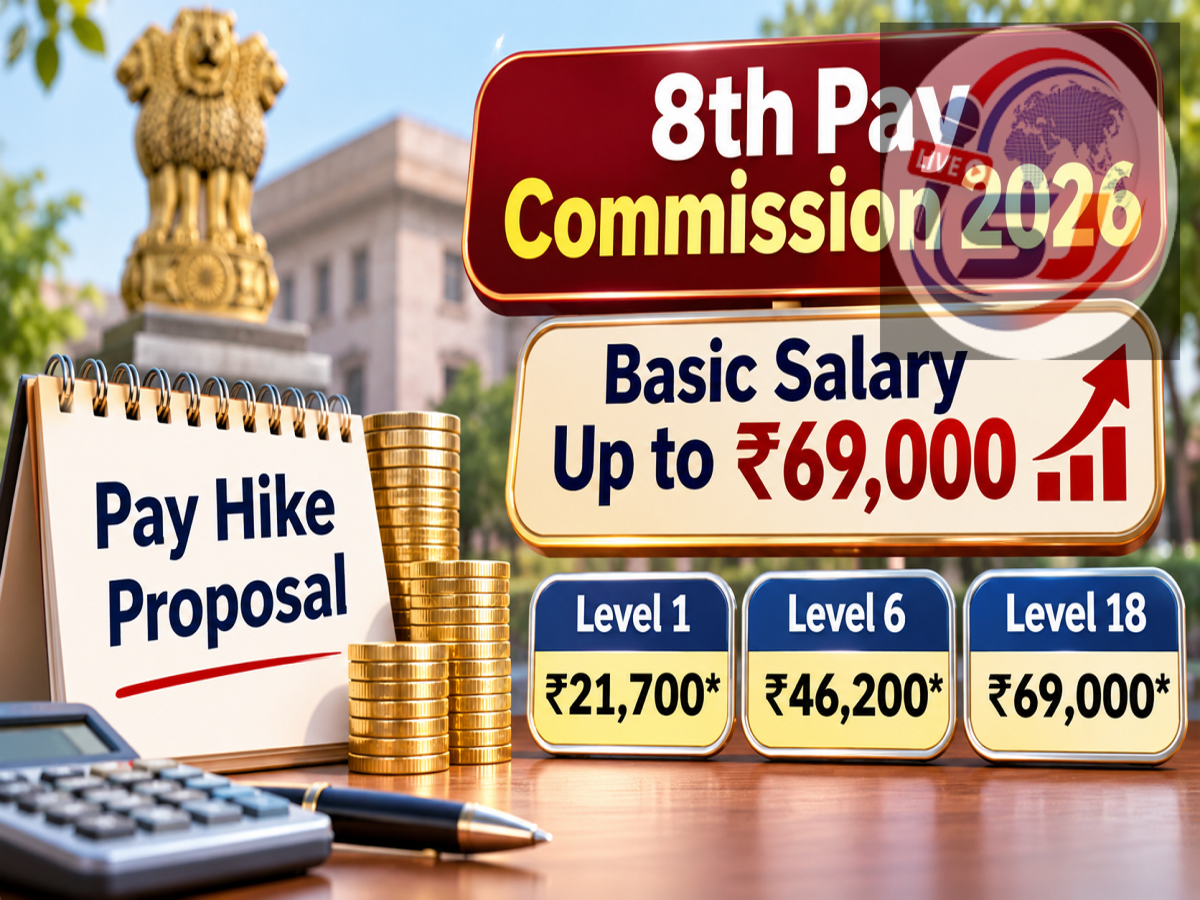
8th Pay Commission Latest Update: Central government employees are closely watching developments surrounding the 8th Central Pay Commission as discussions about revised salaries, pensions, and allowances continue. Several employee organisations have submitted proposals seeking substantial increases in basic pay through higher fitment factors.
Among the proposals attracting attention are fitment factors of 2.92, 3.61, and 3.833. If these demands are accepted, the minimum basic salary for Level 1 employees could rise significantly from the existing ₹18,000.
Some employee groups have suggested a uniform fitment factor for all government employees, while others favour different multiplication factors based on pay levels, job responsibilities, and existing salary structures.
However, these figures remain proposals. The 8th Pay Commission has not announced an approved fitment factor or final revised salary matrix.
Here is how the proposed fitment factors could affect employees under Pay Levels 1, 6, and 18.
What Is the Fitment Factor in the 8th Pay Commission?
The fitment factor is a multiplication formula used to calculate revised basic salaries when a new Central Pay Commission's recommendations are implemented.
It helps determine the new basic pay by multiplying the existing basic salary by the approved factor.
For example, if an employee currently receives ₹18,000 as monthly basic pay and a fitment factor of 3.61 is approved, the illustrative calculation would be:
₹18,000 × 3.61 = ₹64,980
This means the employee's revised basic salary could be approximately ₹65,000, subject to the final pay matrix and government approval.
However, the fitment factor does not represent the same percentage increase in an employee's total take-home salary. Dearness Allowance (DA), House Rent Allowance (HRA), transport allowance, deductions, and other salary components also influence the final amount.
What Was the Fitment Factor Under the 7th Pay Commission?
The 7th Central Pay Commission introduced a uniform fitment factor of 2.57 for revising central government employees' basic salaries.
Under the previous pay structure, the minimum basic pay was ₹7,000. Following implementation of the 7th Pay Commission, it increased to ₹18,000.
Although the multiplication factor was 2.57, this did not translate into an equivalent increase in actual earnings.
The calculation incorporated the existing Dearness Allowance component, which stood at 125% at the relevant reference point. The real increase in basic pay after accounting for DA merger was considerably smaller.
According to the 7th Pay Commission's calculations, the overall increase was approximately 14.2%.
This distinction is important because a higher fitment factor under the 8th Pay Commission would not necessarily mean that employees' actual salaries would rise by the same proportion.
Employee Organisations Demand Fitment Factor of 3.833
The staff side of the National Council–Joint Consultative Machinery (NC-JCM) has reportedly proposed a fitment factor of 3.833.
If implemented, the minimum basic salary for Level 1 employees could increase from ₹18,000 to approximately ₹69,000.
The calculation is:
₹18,000 × 3.833 = ₹68,994
Bharat Pensioners Samaj and the Federation of National Postal Organisations (FNPO) have also reportedly supported proposals involving a fitment factor of around 3.83 and a minimum basic salary close to ₹69,000.
These organisations are seeking changes that they believe would better address inflation and the financial requirements of employees and pensioners.
The government has not approved these demands.
Ministerial Staff Association Proposes 3.61 Fitment Factor
The Ministerial Staff Association (MSA) has reportedly recommended a fitment factor of 3.61.
According to the organisation's proposal, revised basic salaries should reflect rising living costs and help reduce differences between government compensation and salaries offered in other sectors.
Under this proposal, the minimum basic salary for Level 1 employees would increase to approximately ₹64,980, or nearly ₹65,000.
The same factor would produce different revised basic salaries for employees working at higher pay levels.
Railway Employees Seek Different Fitment Factors for Different Pay Levels
The Indian Railway Technical Supervisors Association (IRTSA) has proposed an alternative salary revision model.
Instead of applying a uniform fitment factor to every employee, the association reportedly wants different factors for different pay levels.
Its proposal is based on the argument that job responsibilities, technical requirements, and the nature of work vary across government positions.
The suggested structure is:
| Pay Level |
Proposed Fitment Factor |
|---|---|
| Level 1 |
2.92 |
| Levels 4–8 |
3.50 |
| Levels 9–13 |
3.80 |
| Levels 14–16 |
4.09 |
| Levels 17–18 |
4.38 |
Under this model, the minimum basic salary for Level 1 employees could increase to approximately ₹52,560.
Meanwhile, employees at Level 18 would receive a much higher multiplication factor.
This is an employee association's recommendation, not an approved government policy.
8th Pay Commission Salary Calculator: Levels 1, 6 and 18
To understand the potential impact of the proposed fitment factors, consider the current entry-level or fixed basic salaries under the 7th Pay Commission.
Level 1 employees have a minimum basic salary of ₹18,000, Level 6 begins at ₹35,400, and Level 18 carries a fixed basic salary of ₹2,50,000.
The following table illustrates the revised basic pay under different proposals.
| Fitment Factor Proposal |
Level 1 |
Level 6 |
Level 18 |
|---|---|---|---|
| Current Basic Pay |
₹18,000 |
₹35,400 |
₹2,50,000 |
| 2.57 (Illustrative) |
₹46,260 |
₹90,978 |
₹6,42,500 |
| IRTSA Proposal |
₹52,560 |
₹1,23,900 |
₹10,95,000 |
| 3.61 (MSA) |
₹64,980 |
₹1,27,794 |
₹9,02,500 |
| 3.833 (NC-JCM) |
₹68,994 |
₹1,35,688 |
₹9,58,250 |
Note: The IRTSA figures use different factors for each pay level: 2.92 for Level 1, 3.50 for Level 6, and 4.38 for Level 18. All calculations are illustrative and exclude allowances, deductions, and any adjustments under a future pay matrix.
How Much Could Basic Salary Increase? Try the Calculator
8th Pay Commission Basic Salary Estimator
Select pay level
Level 1 — ₹18,000
Level 6 — ₹35,400
Level 18 — ₹2,50,000
Choose proposed fitment factor
2.57 — Historical reference
3.61 — MSA proposal
3.833 — NC-JCM proposal
IRTSA — Level-specific proposal
Estimated revised basic pay
₹68,994
Increase over existing basic pay
₹50,994
Monthly basic pay estimates only. These are hypothetical calculations, not approved salary rates or take-home pay increases.
Level 18 Employees Could See the Highest Basic Pay Under IRTSA Proposal
Level 18 is the highest level in the regular 7th Central Pay Commission pay matrix, with a fixed basic salary of ₹2.5 lakh per month.
IRTSA's proposed factor of 4.38 would produce a revised basic salary of ₹10.95 lakh per month through simple multiplication.
By comparison, a uniform factor of 3.61 would produce approximately ₹9.03 lakh, while a factor of 3.833 would result in approximately ₹9.58 lakh.
These calculations illustrate the scale of the proposals. They should not be interpreted as realistic salary forecasts or official recommendations.
The commission may recommend a different formula, revise the pay matrix, or propose other adjustments before the government takes a final decision.
Will Dearness Allowance Be Merged Into Basic Salary?
Dearness Allowance is an important component of central government employee compensation.
When a new Pay Commission's recommendations are implemented, the revised basic pay calculation generally accounts for the DA prevailing at the relevant reference date.
For this reason, the proposed multiplication factor cannot be interpreted as a direct increase in take-home earnings.
Employees also receive allowances such as HRA and transport allowance, depending on their eligibility and posting location.
Any revised allowance structure will depend on the recommendations accepted by the government.
When Will the 8th Pay Commission Submit Its Report?
The 8th Central Pay Commission was formally constituted on November 3, 2025, and has been given 18 months to submit its recommendations.
Based on this timeline, its report is expected around May 2027, although the actual submission and implementation schedule may vary.
After receiving the report, the central government will examine its recommendations and determine the final pay structure, fitment factor, allowances, and pension-related provisions.
The implementation date and any retrospective financial benefits will also depend on official government decisions.
As of November 12, 2026, no final fitment factor has been approved.
What Should Central Government Employees Expect?
The proposals submitted by employee organisations demonstrate the different approaches being considered for salary revision under the 8th Pay Commission.
While some groups favour a uniform factor of 3.61 or 3.833, IRTSA has recommended a differentiated system based on pay levels.
The final outcome could differ substantially from these demands.
Employees should therefore avoid treating social media salary charts or unofficial fitment factor calculations as confirmed government announcements.
Official updates from the Ministry of Finance, Department of Expenditure, and the 8th Central Pay Commission will provide the authoritative position.
Final Update
The demand for a higher fitment factor has renewed expectations of a significant salary revision for central government employees.
Under the proposals currently being discussed, Level 1 basic pay could range from approximately ₹52,560 to ₹68,994, while the calculations for Levels 6 and 18 show considerably larger amounts.
However, none of these proposed salary figures has received final government approval.
The actual increase will become clear only after the 8th Pay Commission submits its recommendations and the central government announces its decisions.
Disclaimer: All revised salary figures are hypothetical estimates based on employee organisations' reported proposals. They do not represent officially approved salaries, pension increases, or government commitments.