
8th Pay Commission 2026: 11 Months Later, What Has Been Decided on Salary Hike, Fitment Factor and DA Merger?
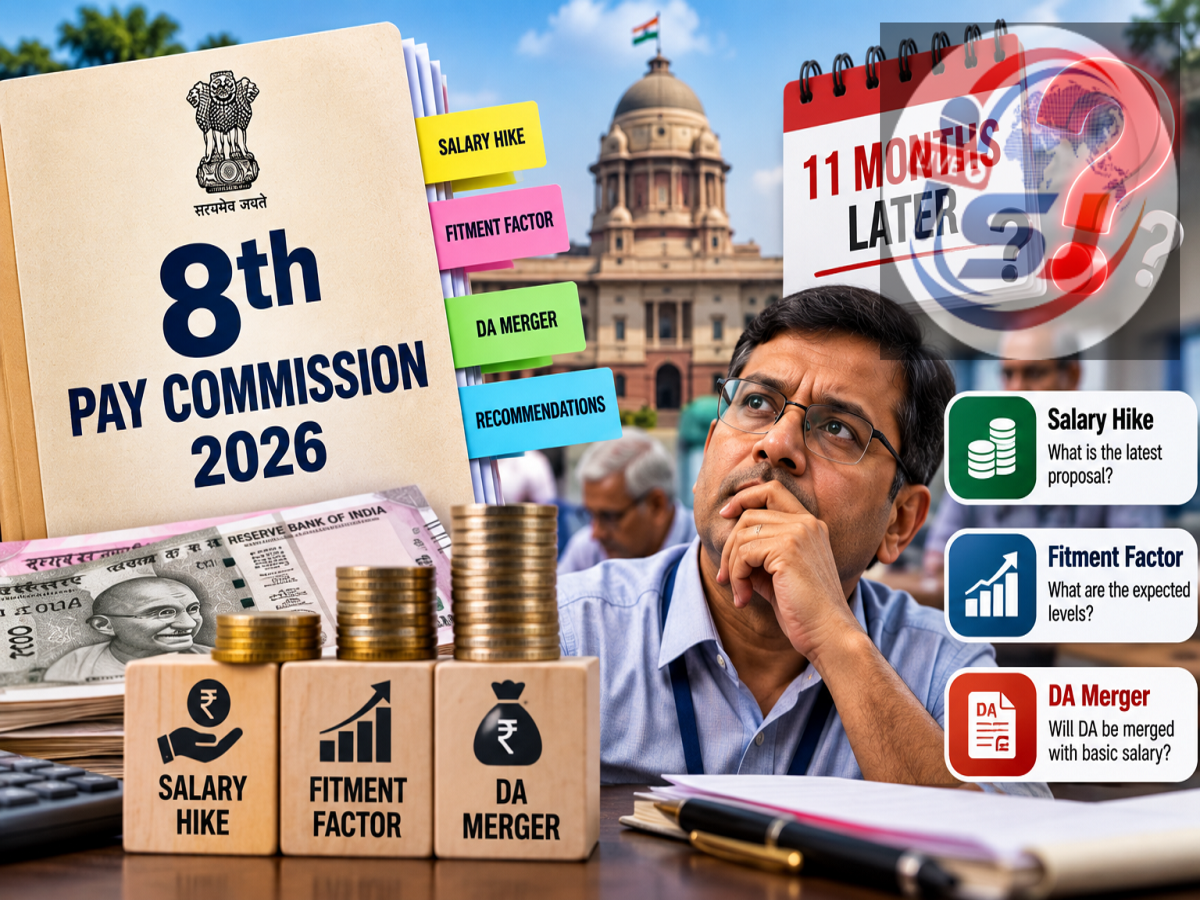
8th Pay Commission Latest News, October 12, 2026: Nearly 11 months have passed since the constitution of the 8th Central Pay Commission, and millions of central government employees and pensioners are eagerly waiting for clarity on their revised salaries, pensions, fitment factor, and Dearness Allowance (DA) merger.
The commission, headed by Justice Ranjana Prakash Desai, has reportedly been holding discussions with employee associations and pensioners' organisations to understand their expectations regarding the next pay revision.
Several employee unions have submitted proposals seeking a substantial increase in minimum basic pay, a higher fitment factor, and changes to the existing DA structure.
One of the most prominent demands is a 3.833 fitment factor, which could theoretically increase the minimum basic salary from ₹18,000 to approximately ₹69,000.
However, it is important to understand that these figures are currently demands and calculations, not approved salary revisions.
Here is a detailed look at the reported progress of the 8th Pay Commission, the major proposals under discussion, and what employees should expect next.
8th Pay Commission: What Has Happened in the Last 11 Months?
According to the reported timeline, the 8th Central Pay Commission was constituted on November 3, 2025.
The three-member panel is headed by Justice Ranjana Prakash Desai.
Since its formation, the commission has reportedly been engaging with employee representatives, pensioners' organisations, and other stakeholders.
Meetings have been reported in several locations, including Delhi, Ladakh, West Bengal, and Puducherry.
A significant discussion was also reported in Bengaluru on October 8, 2026.
During these interactions, employee organisations have raised several concerns about salary structures, inflation, pensions, allowances, and the fitment factor.
The next round of discussions is reportedly expected to take place in Mumbai on October 22 and 23, 2026.
These meetings are important because they provide an opportunity for employee groups to present their demands before the commission prepares its recommendations.
However, discussions and submissions should not be confused with final government decisions.
Has the 8th Pay Commission Approved a Salary Hike?
As of the information presented in the October 12 report, no final revised pay matrix or fitment factor has been announced through the commission's recommendations.
Employee organisations have submitted various proposals, but the final salary structure remains undecided.
The commission must examine multiple factors before making recommendations, including inflation, employee requirements, pension liabilities, and the financial implications for the government.
Once the recommendations are submitted, the central government will consider them and decide which changes to approve.
Therefore, employees should avoid treating projected salary figures circulating online as officially confirmed amounts.
DA Reportedly Reached 60%: Why Does It Matter?
Dearness Allowance is an important component of central government employees' compensation.
It is intended to provide partial protection against the impact of rising prices.
DA is calculated as a percentage of basic pay and is generally revised periodically using the applicable inflation-linked formula.
According to the supplied report, employee organisations have referred to DA reaching 60% in January 2026.
As DA increases, employee associations often argue that the next pay revision should adequately reflect changes in living costs.
This is one reason the fitment factor has become a major subject of discussion.
A higher fitment factor could result in a larger revised basic salary, although the actual increase in total pay depends on how the new pay structure and allowances are designed.
What Is the Fitment Factor in the 8th Pay Commission?
The fitment factor is a multiplier used to calculate revised basic pay under a new pay structure.
For example, if an employee's existing basic salary is ₹18,000 and a fitment factor of 3.833 is applied, the revised amount would be:
₹18,000 × 3.833 = ₹68,994
This is approximately ₹69,000.
Under the 7th Central Pay Commission, the commonly referenced fitment factor was 2.57.
For the 6th Pay Commission, a factor of 1.86 was used in the relevant pay revision framework.
Several employee organisations are now seeking a higher multiplier under the 8th Pay Commission.
However, the government has not approved a 3.833 fitment factor merely because it has been proposed.
Employee Unions Demand 3.833 Fitment Factor and ₹69,000 Minimum Basic Pay
One of the major proposals has reportedly come from the employee side of the National Council–Joint Consultative Machinery (NC-JCM).
The organisation has sought a fitment factor of 3.833.
If applied to the current minimum basic pay of ₹18,000, this would produce a revised figure of approximately ₹68,994.
Bharat Pensioners Samaj has also reportedly proposed a fitment factor of around 3.83.
Meanwhile, the Ministerial Staff Association of the Survey of India has reportedly demanded a multiplier of 3.61.
These proposals reflect different approaches to calculating revised salaries and pensions.
The commission will need to examine such submissions before deciding what to recommend.
8th Pay Commission Salary Calculation: What Different Fitment Factors Could Mean
The following table shows illustrative revised basic salaries under different proposed or hypothetical fitment factors.
| Existing Basic Pay | At 2.57 Factor | At 3.61 Factor | At 3.833 Factor |
|---|---|---|---|
| ₹18,000 | ₹46,260 | ₹64,980 | ₹68,994 |
| ₹25,500 | ₹65,535 | ₹92,055 | ₹97,742 |
| ₹35,400 | ₹90,978 | ₹1,27,794 | ₹1,35,688 |
| ₹44,900 | ₹1,15,393 | ₹1,62,089 | ₹1,72,112 |
| ₹56,100 | ₹1,44,177 | ₹2,02,521 | ₹2,15,031 |
Important: These are mathematical illustrations, not approved 8th Pay Commission salary figures. Actual revised pay may depend on the final pay matrix, rounding rules, approved fitment factor, and treatment of existing allowances.
Will Dearness Allowance Be Merged With Basic Salary?
Another major issue being discussed is the possible merger of Dearness Allowance with basic pay.
Employee organisations have been demanding changes to the existing system to better account for inflation.
The idea behind DA merger is to incorporate some or all of the accumulated allowance into the basic salary structure.
Such a change could affect the calculation of other benefits linked to basic pay.
However, there is no confirmed final decision in the supplied report approving a DA merger under the 8th Pay Commission.
The timing, percentage, and method of any possible merger remain uncertain.
Employees should therefore distinguish between union demands and officially approved rules.
What Has FNPO Proposed Regarding DA Merger?
The Federation of National Postal Organisations (FNPO) has reportedly suggested establishing a permanent mechanism for reviewing employee salaries.
Under its proposal, when DA or Dearness Relief (DR) reaches 50%, a revised fitment factor should be recommended within 90 days.
The organisation has also suggested that DA or DR exceeding 25% should be considered for merger with basic pay or basic pension.
The objective is to make salary and pension revisions more responsive to inflation.
This would represent a significant change from the traditional system of periodic pay commission reviews.
However, the proposal remains a recommendation from an employee organisation.
It has not been established as a new government rule.
Pensioners Also Demand Changes to Dearness Relief
The 8th Pay Commission is important not only for serving employees but also for central government pensioners.
Pensioners receive Dearness Relief, which is intended to help offset inflation.
Organisations representing retired employees have sought improvements to pension calculations and the treatment of DR.
Bharat Pensioners Samaj has reportedly raised the issue of merging DR with basic pension.
A higher fitment factor has also been proposed to improve revised pension calculations.
However, the commission's final recommendations on pension revision are still awaited.
Any changes would require the necessary government approval and implementation orders.
Will the Minimum Basic Pension Increase Under the 8th Pay Commission?
The existing minimum basic pension commonly referenced under the 7th Pay Commission framework is ₹9,000.
If a fitment factor of 3.833 were applied directly to that amount, the illustrative calculation would be:
₹9,000 × 3.833 = ₹34,497
This is approximately ₹34,500.
However, it would be incorrect to conclude that all eligible pensioners will automatically receive this amount.
The revised pension formula, applicable eligibility conditions, and treatment of existing pension components have not yet been finalised.
The figure is useful only for understanding the possible effect of the proposed multiplier.
When Could the 8th Pay Commission Submit Its Report?
According to the supplied report, the commission's recommendations are being anticipated around May or June 2027.
This is a reported expectation rather than a confirmed publication date.
The commission must first complete its consultations, examine employee demands, and prepare its recommendations.
After the report is submitted, the central government will review the proposals.
The government may approve, modify, or reject individual recommendations.
Only after the relevant decisions and notifications are issued will employees have clarity about the revised basic pay, pension, allowances, and implementation arrangements.
Will Employees Receive Salary Arrears?
Salary arrears are another important concern for central government employees.
If a revised pay structure is implemented retrospectively, eligible employees could potentially receive arrears for the applicable period.
However, this depends on the effective date and implementation rules approved by the government.
There is no basis in the supplied report to calculate a confirmed arrears amount or payment date.
Employees should wait for official orders before making financial plans based on expected arrears.
What Should Central Government Employees Watch Next?
Several developments will be important in the coming months.
The reported Mumbai discussions scheduled for October 22 and 23, 2026, could provide further insight into the demands being presented.
Employees will also be watching for updates on the proposed fitment factor, minimum basic pay, pension revision, and DA merger.
The commission's eventual report will be the most important milestone.
Even then, the recommendations will need to be considered by the central government before any changes become effective.
For now, salary projections should be treated as estimates rather than guaranteed benefits.
8th Pay Commission 2026: Latest Status at a Glance
| Major Issue | Reported Status |
|---|---|
| Commission formation | November 3, 2025, according to the supplied report |
| Chairperson | Justice Ranjana Prakash Desai |
| Salary revision | Final revised pay matrix awaited |
| 3.833 fitment factor | Demand raised by employee representatives |
| ₹69,000 minimum basic pay | Proposed figure, not approved |
| DA merger | Demanded by employee organisations; no confirmed approval |
| Pension revision | Proposals under discussion |
| Next reported meeting | Mumbai, October 22–23, 2026 |
| Expected report period | May–June 2027, according to the report; not confirmed |
| Government implementation | Subject to final recommendations and approval |
Final Takeaway
The 8th Pay Commission remains a major focus for central government employees and pensioners.
Nearly 11 months after its reported formation, employee organisations have presented several demands, including a higher fitment factor, an increase in minimum basic pay, changes to pension calculations, and a possible merger of DA with basic salary.
The proposed 3.833 fitment factor has attracted particular attention because it could mathematically raise the current ₹18,000 minimum basic pay to approximately ₹69,000.
However, neither the ₹69,000 minimum salary nor the DA merger has been confirmed as an approved 8th Pay Commission decision.
The next important developments will be further consultations, the commission's recommendations, and the central government's eventual decision.
Until then, employees and pensioners should rely on official announcements rather than unverified salary projections.
Disclaimer: The figures and timelines discussed in this article are based on the supplied report and employee organisations' proposals. Illustrative salary and pension calculations do not represent approved government benefits. Final changes will depend on official recommendations, government approval, and implementation notifications.
Tighten the opening for clarityReduce repeated qualification paragraphs