
444-Day FD Schemes Gain Popularity: Why Banks Are Offering Special Fixed Deposit Tenures
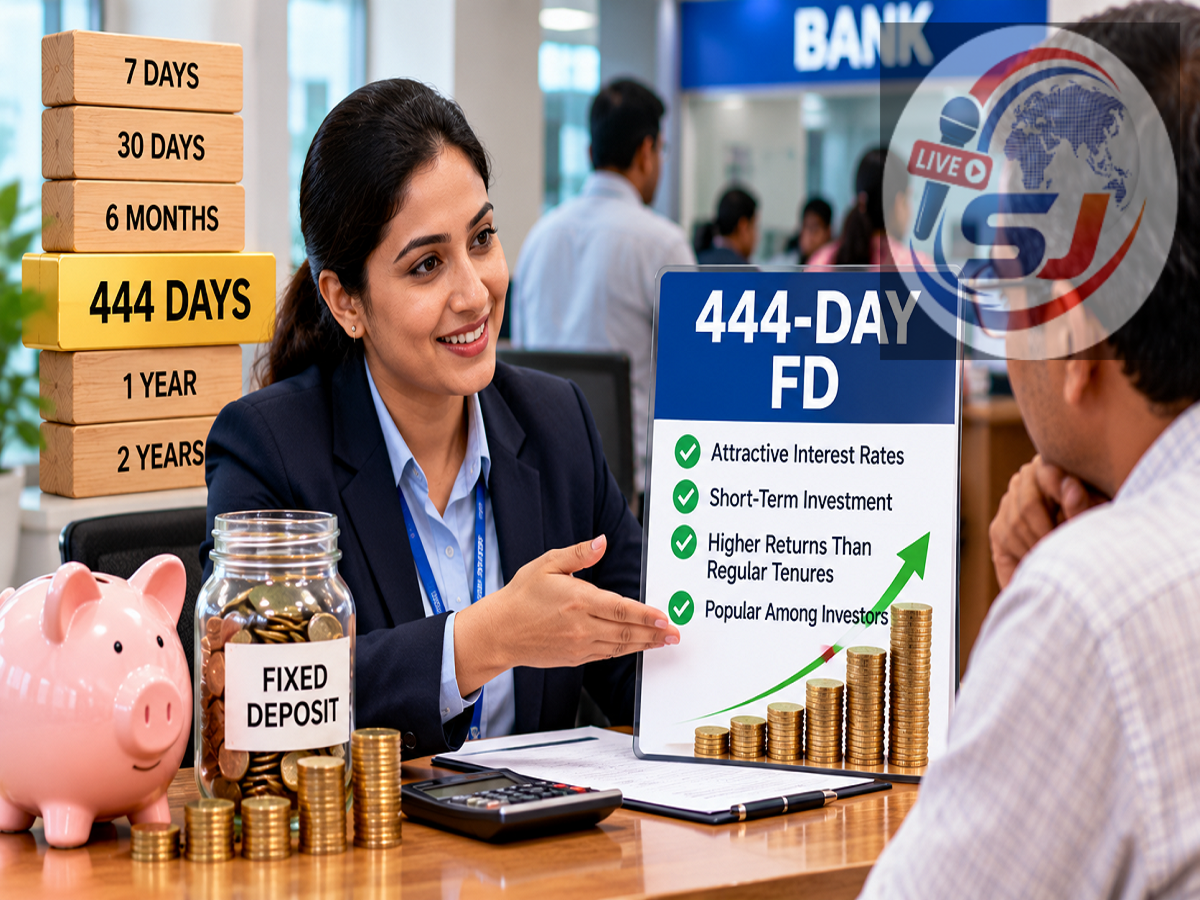
444 Days FD Scheme: Fixed deposits continue to be a popular savings option among people who prefer predictable returns and do not want their money directly exposed to stock-market volatility. To attract such depositors, several banks offer special-tenure fixed deposits, and 444-day FD schemes have emerged as one of the widely discussed options.
Large banks periodically introduce special fixed deposits with unusual tenures such as 400, 444 or other specific numbers of days. These schemes may offer different interest rates compared with standard one-year or two-year deposits.
For customers, however, the highest advertised interest rate should not be the only factor considered before investing.
Why Are 444-Day FDs Getting Attention?
Traditional fixed deposits are usually associated with standard periods such as six months, one year, two years, three years or five years.
Special-tenure deposits work slightly differently.
Banks can introduce deposits for a specific number of days and offer a separate interest rate for that maturity period. A 444-day FD falls into this category.
The tenure is a little longer than one year but considerably shorter than two years, making it potentially suitable for depositors who do not want to lock their money away for a very long period.
Another attraction is that banks may price these special deposits more competitively than some of their regular FD tenures.
SBI, PNB and Other Banks Offer Different FD Options
Major banks, including State Bank of India (SBI), Punjab National Bank (PNB) and other public and private sector lenders, offer fixed deposits across multiple maturity periods.
Some banks also run special-tenure schemes designed to attract fresh deposits.
However, interest rates are not necessarily identical across banks.
The rate can vary according to the deposit tenure, customer's age, deposit amount and the specific scheme selected.
Senior citizens are also commonly offered an additional rate over the corresponding rate available to general customers, subject to the bank's terms.
This means the bank offering the most attractive return for one category of depositor may not necessarily provide the highest rate for another.
Check the Latest Rate Before Investing
Fixed-deposit interest rates can change.
A bank offering an attractive rate on a 444-day deposit today could revise it later depending on liquidity requirements, market interest rates and its own deposit strategy.
Therefore, investors should verify the latest rate directly with the bank before opening an FD.
They should also confirm whether the special deposit is currently open for fresh investment.
Some special-tenure FD schemes may be available only for a limited period, while others can be extended, modified or withdrawn.
Regular and Senior Citizen Rates Can Differ
Senior citizens should pay particular attention to the separate rate offered to them.
Banks generally provide eligible senior citizens with an additional interest-rate benefit on selected fixed deposits.
As a result, a 444-day FD may generate a higher maturity amount for an eligible senior citizen than for a general depositor investing the same amount.
The exact additional rate depends on the bank and scheme.
Customers should therefore compare rates within the correct category rather than relying only on the headline interest rate shown in an advertisement.
How Does a 444-Day FD Work?
The basic structure is similar to a conventional fixed deposit.
A customer deposits a lump sum with the bank for 444 days. The applicable interest rate is generally locked according to the scheme's terms when the deposit is booked.
Interest is calculated according to the bank's applicable method and the payout option selected.
At maturity, the customer receives the principal along with the applicable interest in a cumulative FD.
Alternatively, some deposits may provide periodic interest payouts, depending on the scheme and option selected.
The maturity value will depend on the investment amount, applicable interest rate, compounding method and deposit terms.
Don't Compare FDs Only by Headline Interest Rate
Suppose one bank advertises a higher interest rate than another.
That does not automatically make it the best option for every customer.
Depositors should also examine premature-withdrawal rules.
If money is needed before the FD matures, the bank may apply a lower interest rate or impose a premature-withdrawal penalty according to its rules.
This can reduce the effective return.
Customers should also check whether the FD can be automatically renewed at maturity and what interest rate would apply to the renewed deposit.
Tax on FD Interest Is Important
Interest earned from bank fixed deposits is generally taxable according to the depositor's applicable income-tax rules.
Banks may also deduct tax at source when applicable conditions and thresholds are met.
Therefore, the advertised FD rate is a pre-tax interest rate, not necessarily the depositor's final post-tax return.
Someone in a higher tax bracket can have a substantially different effective return from an investor with little or no taxable income.
Depositors should consider the post-tax return while comparing an FD with other savings and investment options.
Is a 444-Day FD Suitable for Everyone?
Not necessarily.
A 444-day deposit can be useful when an investor has money that will not be required for approximately the next 14 to 15 months and wants a predictable return.
But investors who may need the money at short notice should pay close attention to liquidity and premature-withdrawal conditions.
Similarly, people investing for long-term goals should not automatically select a 444-day FD merely because its current interest rate looks attractive.
The investment tenure should ideally match the financial goal.
Deposit Insurance Is Another Factor to Understand
Bank depositors should also understand how deposit insurance works.
Eligible deposits with an insured bank are covered by the Deposit Insurance and Credit Guarantee Corporation (DICGC) up to the applicable statutory limit, subject to its rules.
The coverage applies on an aggregate basis per depositor per bank in the same right and capacity, rather than separately to every FD.
This can be an important consideration for people placing large amounts in fixed deposits.
What Should You Compare Before Booking an FD?
Before investing in a 444-day special FD, compare the latest interest rate for your customer category, maturity amount, premature-withdrawal conditions, payout options and tax implications.
Also check whether the special scheme has a booking deadline.
If two banks offer similar rates, factors such as convenience, digital banking facilities and liquidity conditions may help determine which deposit better suits your needs.
444-Day FDs Can Be Attractive, But Check Current Rates
The popularity of 444-day fixed deposits highlights how banks are using special maturity periods to attract depositors looking for predictable returns.
For customers, these schemes can provide an alternative to conventional one-year or two-year deposits.
However, there is no reason to select an FD merely because it carries the "444-day" label.
The actual benefit depends on the interest rate available on the date of investment, senior-citizen benefit where applicable, premature-withdrawal rules, taxation and the investor's financial needs.
Since bank FD rates can be revised, customers should check the latest official rates before deciding which bank currently offers the most attractive 444-day deposit.