
300 units of free electricity, 'Zero' bill; get a ₹98,000 subsidy under the PM Surya Ghar scheme here
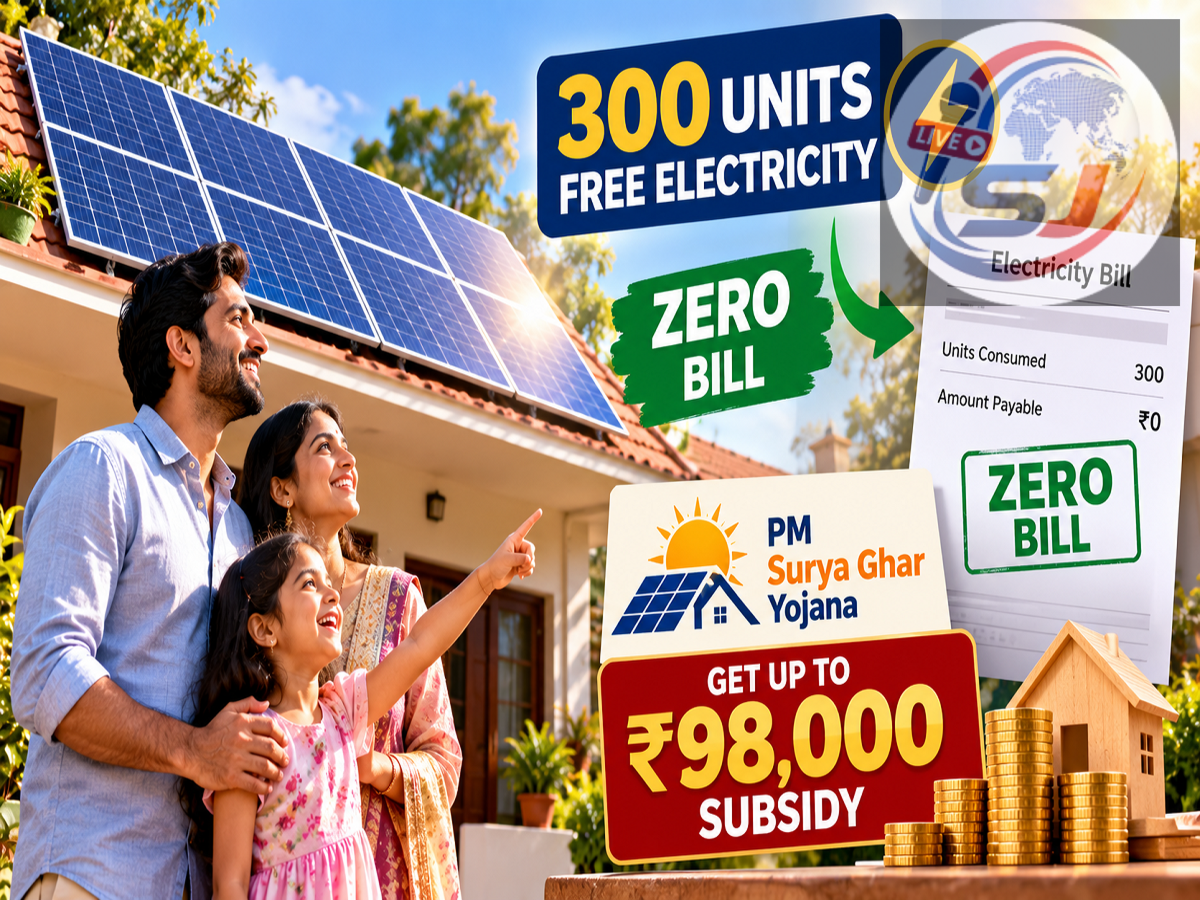
PM Surya Ghar Muft Bijli Yojana 2026: Installing rooftop solar can significantly reduce a household's monthly electricity expenses, and consumers in Bihar may have an additional incentive to consider the switch. Under the PM Surya Ghar: Muft Bijli Yojana, eligible households receive central financial assistance for installing residential rooftop solar systems, while additional state-level support can increase the overall benefit in Bihar.
The central government launched the scheme in February 2024 with the objective of expanding residential rooftop solar and helping households generate up to around 300 units of electricity per month through appropriately sized systems.
Under the standard central subsidy structure, financial assistance can reach ₹78,000 for a 3 kW or larger eligible residential rooftop solar installation. The ₹98,000 figure highlighted for Bihar includes additional state-level assistance cited in the report rather than ₹98,000 being the standard central subsidy available throughout India.
How Does PM Surya Ghar Muft Bijli Yojana Work?
The scheme encourages households to install solar panels on their rooftops and use the electricity generated for their own consumption.
The central government approved PM Surya Ghar with an overall outlay of ₹75,021 crore and a target of rooftop solar installations for one crore households. The scheme is designed to help participating households generate up to around 300 units of electricity a month, depending on the size of the solar system and actual generation conditions.
A 3 kW rooftop system can generate more than 300 units in an average month under suitable conditions, according to the government's original scheme framework.
However, "300 units free" should not be interpreted as an automatic monthly waiver of exactly 300 grid-electricity units for every beneficiary. The benefit comes primarily from electricity generated by the household's rooftop solar system, which reduces the amount of electricity that needs to be purchased from the grid.
How Much Central Subsidy Is Available?
The central subsidy depends on the capacity of the rooftop solar system.
For a 1 kW system, central assistance can be ₹30,000.
For a 2 kW system, it can reach ₹60,000.
For a 3 kW or larger system, the central financial assistance is capped at ₹78,000 under the standard subsidy structure.
The government's guidance broadly links average monthly electricity consumption with an appropriate rooftop system as follows:
| Average Monthly Consumption | Suggested Solar Capacity | Central Subsidy |
|---|---|---|
| 0–150 units | 1–2 kW | ₹30,000–₹60,000 |
| 150–300 units | 2–3 kW | ₹60,000–₹78,000 |
| Above 300 units | Above 3 kW | Up to ₹78,000 |
This means installing a system larger than 3 kW does not automatically keep increasing the central subsidy. Under the standard structure, central financial assistance is capped at the eligible amount for 3 kW.
How Does the ₹98,000 Benefit Work in Bihar?
The higher figure being discussed for Bihar comes from combining the applicable central assistance with additional support cited for the state.
For example, if an eligible household installing a 3 kW rooftop solar system receives the maximum central subsidy of:
Central subsidy: ₹78,000
and receives an additional:
Bihar support: ₹20,000
the combined assistance would become:
₹78,000 + ₹20,000 = ₹98,000
Therefore, the headline ₹98,000 benefit should not be interpreted as a new nationwide central subsidy.
The central component remains up to ₹78,000 under the standard PM Surya Ghar framework, while the remaining amount in this example comes from the Bihar-specific benefit described in the source.
Applicants should confirm the availability, eligibility requirements and current terms of any state-level assistance before calculating their final out-of-pocket cost.
Can Your Electricity Bill Really Become Zero?
It is possible for some rooftop-solar households to record a zero electricity bill in certain months, but this is not guaranteed for every beneficiary.
Government data released in July 2026 said electricity bills had been substantially reduced for households with installations under the scheme, while more than 18.93 lakh households had reported zero electricity bills for some months, depending on their own electricity consumption and solar generation.
Whether an individual household receives a zero bill depends on factors such as electricity consumption, rooftop solar capacity, sunlight, seasonal generation, net-metering arrangements and applicable DISCOM billing rules.
A family consuming less electricity than its solar system produces could see a very low or even zero energy bill under appropriate conditions.
But a household with high consumption may still have to pay for additional electricity drawn from the grid.
What Does '300 Units Free' Actually Mean?
This is another point where consumers should avoid confusion.
The scheme is designed so that an appropriately sized rooftop solar installation—typically around 3 kW—can generate roughly 300 units or more per month on average under suitable conditions.
Suppose a household consumes around 280 units in a month and its solar system generates enough electricity to offset most or all of that consumption under the applicable metering mechanism. Its grid electricity expense could fall sharply.
If the same household consumes 500 units, rooftop generation may offset only part of the consumption, leaving the household to pay for the remaining electricity according to applicable tariff and billing rules.
Therefore, the actual saving varies from one household to another.
Who Can Apply for PM Surya Ghar?
The scheme is demand-driven and is available to eligible residential electricity consumers with a grid-connected electricity connection from their local DISCOM.
The rooftop must also be suitable for installing the required solar system.
Applicants need to complete the prescribed registration and installation process and use eligible vendors and equipment according to the scheme's requirements.
The final subsidy depends on the approved solar capacity and successful completion of the required verification and commissioning process.
More Than 48 Lakh Households Covered by July 2026
The rooftop solar programme has expanded significantly since its launch.
According to information provided by the Ministry of New and Renewable Energy in July 2026, 39,72,447 rooftop solar systems had been installed, covering 48,02,717 households as of July 22, 2026.
The government also allocated ₹22,000 crore to the scheme for FY 2026-27.
This shows the rapid expansion of residential rooftop solar installations, although the figures should not be confused with the scheme's ultimate target of one crore households.
Low-Interest Financing Is Also Available
Households that cannot pay the entire installation cost upfront may also have access to financing.
The government stated in July 2026 that collateral-free loans were available from nationalised banks for eligible residential rooftop solar systems at concessional interest rates.
The actual loan rate, tenure, eligibility and EMI should be checked with the participating lender before applying.
A subsidy reduces the installation cost, but any remaining amount financed through a loan still has to be repaid.
How to Apply for the Scheme
Eligible consumers can apply through the official PM Surya Ghar National Portal.
Applicants generally need to register using their state, electricity distribution company and consumer details, select the appropriate rooftop solar capacity and proceed according to the portal's installation process.
After installation by an eligible vendor and completion of the required DISCOM inspection and commissioning process, the consumer can complete the prescribed subsidy-related formalities.
Consumers should use authorised channels and avoid agents promising unusually high subsidies in exchange for advance payments or sensitive banking credentials.
₹98,000 Subsidy: What Bihar Consumers Should Remember
The biggest point is that the ₹98,000 figure is not the standard PM Surya Ghar central subsidy across India.
Under the central framework, the maximum standard financial assistance is ₹78,000 for an eligible 3 kW or larger residential rooftop system.
For Bihar households, the total can reach the higher figure cited in the report when applicable state-level assistance is added to the central benefit.
Similarly, the widely used phrase "300 units free electricity" should be understood in the context of rooftop solar generation. Actual monthly savings depend on how much electricity a household consumes and generates.
For eligible households with sufficient rooftop space and suitable electricity consumption, the combination of central subsidy, applicable Bihar support and long-term solar generation can substantially reduce dependence on grid electricity and lower monthly power expenses.